Crypto Scam Prevention Guide 2026: How to Spot, Avoid, and Respond
Crypto scams drain billions every year — and most victims thought they were careful. This how-to guide covers 10 scam types, step-by-step prevention rules, a security checklist, and what to do if you get hit.

Last updated
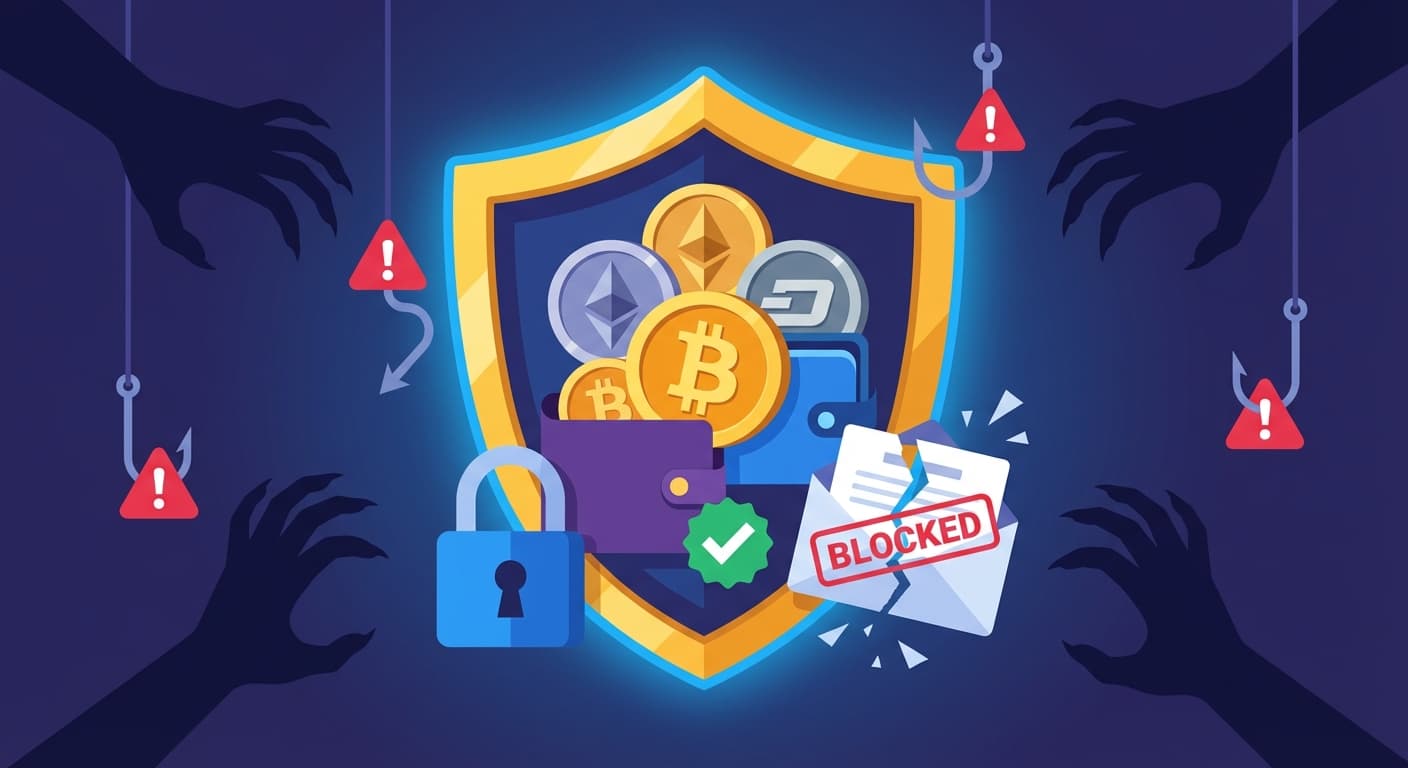
Imagine logging into your wallet one morning and seeing a zero balance — not because of a market crash, but because a scammer drained it while you slept. It happens every single day. And most victims thought they were careful enough.
This guide is part of the Crypto Wallets & Security series. We'll walk through the most dangerous scam types active right now, give you concrete prevention steps for each, and tell you exactly what to do if something goes wrong.
Not financial advice (NFA). Crypto markets are volatile and high-risk. Everything here is for informational purposes only — DYOR before making any decisions.
Why Crypto Scams Are So Dangerous Right Now
Scammers target crypto specifically because transactions are irreversible. There is no "dispute this charge" option. Once the funds leave your wallet, they are almost certainly gone.
| Metric | Figure |
|---|---|
| Total reported losses (2025) | $17 billion |
| January 2026 phishing losses | $311M (one incident alone: $284M) |
| Impersonation scam growth | 1,400% year-over-year |
| Average loss per victim (2025) | $2,764 (up from $782 in 2024) |
| Phishing share of individual losses | 45% |
These are not distant edge cases. Every number represents real people who followed standard advice — and still got hit. Understanding how the attacks work is your first layer of defense.
The 10 Most Common Crypto Scam Types
1. Phishing Attacks
Think of phishing like a counterfeit key — it looks identical to the real thing, but opens a trap door instead of your wallet.
- How it works: Fake websites, emails, or DMs impersonate exchanges and wallet services, then steal your login credentials or seed phrases
- Signature phishing surge: In January 2026, signature phishing grew 207% month-over-month — attackers trick you into signing a transaction that hands them full control of your wallet
- Scale: $311M lost in January 2026 alone
Warning
Never click links in emails or DMs claiming to be from an exchange or wallet provider. Always type the URL directly or use a verified bookmark.
Prevention:
- Type URLs directly or use bookmarks — every time, no exceptions
- Before signing any wallet transaction, read what you are actually approving
- Check the URL in your browser bar before entering credentials
2. Rug Pulls
A rug pull works like a carnival game: the prize looks real right up until the moment you pay for it, then the booth folds and disappears.
- How it works: Developers launch a new token, hype it on social media, let the price pump, then dump their holdings and vanish with the funds
- Common targets: Memecoins, new DEX tokens with thin liquidity
- Scale: Billions lost annually across all chains
Tip
Before investing in any new token, check whether liquidity is locked on a third-party locker platform and for how long. Unlocked liquidity is a major red flag.
Prevention:
- Verify that liquidity is locked on a third-party locker with a meaningful timeframe
- Look for independent security audits from reputable firms
- Be wary of anonymous teams with no verifiable professional history
- Confirm the smart contract code is open-source and matches the published audit
3. Pig Butchering
This is the long con of crypto scams. Attackers invest weeks or months building a relationship before making their move.
- How it works: Contact via dating app or social media → build genuine-feeling rapport over weeks → introduce a "limited access" crypto investment opportunity → direct target to a fake exchange → when withdrawal is attempted, fees escalate infinitely or access is blocked entirely
- Name origin: "Fatten the pig before slaughter"
- Scale: The US DOJ seized $61M in USDT linked to pig butchering operations in February 2026
Warning
Any investment advice from someone you met online — even after months of friendly conversation — deserves extreme skepticism. The longer the trust-building phase, the larger the intended scam.
Prevention:
- Treat any investment recommendation from an online acquaintance you have never met in person as a scam until independently verified
- Never use an exchange or platform recommended solely by someone you know only online
- "Guaranteed returns" is always a scam signal — no exceptions
4. Fake Airdrops and Token Approval Scams
Unknown tokens appear in your wallet. Swapping them or claiming a "free airdrop" triggers a malicious contract that drains everything.
- Method A: Unknown tokens appear → attempting to swap them executes a malicious contract that empties your wallet
- Method B: Fake "airdrop claim" site requests unlimited token approval, giving attackers ongoing access to your funds
- 2026 trend: "Zero-value transfer" spam — $0 transactions that plant attacker addresses in your wallet history, hoping you'll copy-paste one when sending real funds (100M+ instances detected on BSC alone)
Prevention:
- Never interact with unknown tokens that appear in your wallet
- Never grant unlimited token approvals to any DeFi protocol
- Use revoke.cash to regularly audit and revoke existing approvals
- Only claim airdrops through a project's official website or verified Discord
5. Fake Exchange and Wallet Apps
Counterfeit apps look identical to legitimate wallets and exchanges — right down to the logo and screenshots.
- How it works: Published to app stores with similar names and developer accounts → accepts deposits → blocks withdrawals
- Discovery tactic: Paid search ads sometimes place fake apps above the legitimate ones in search results
Prevention:
- Only download apps through links listed on the project's official website
- Check developer name, publication date, and review count carefully
- Test with a small deposit and a small withdrawal before committing significant funds
6. Malicious Browser Extensions
A bad extension can silently rewrite your outgoing transactions in real time — swapping the recipient address while your screen still shows the "correct" one.
Caution
Minimize the number of browser extensions you run. Even a 4.5-star extension can be compromised if it was recently acquired by a new owner or pushed a suspicious update.
Prevention:
- Keep browser extensions to the absolute minimum you need
- Remove unused extensions immediately
- Only install extensions from verified developers with long public track records
- After every transaction, verify the recipient address on a block explorer matches your intent
7. Ponzi and Pyramid Schemes
New investor money funds payouts to earlier investors. It works until it doesn't — and the collapse is always sudden.
- Red flags: Fixed daily percentage returns, heavy emphasis on referral bonuses
- Historical examples: BitConnect (2018), PlusToken ($3B collapse), Terra/LUNA's Anchor Protocol (20% APY promises before implosion)
Prevention:
- Unrealistically high fixed returns are the single most reliable scam signal — full stop
- Ask yourself: where does the yield actually come from? If there is no clear answer, walk away
- Avoid any project structurally dependent on recruiting new participants
8. SIM Swapping
No technical hacking required. Attackers social-engineer your mobile carrier into porting your phone number to their SIM card, then intercept your SMS 2FA codes.
- How it works: Attacker calls carrier support with your personal details → number is ported → attacker intercepts 2FA texts → exchange account drained
- Impact: Complete account takeover with zero technical skill required on the attacker's end
Prevention:
- Switch to app-based 2FA (Google Authenticator or Authy) instead of SMS — this is non-negotiable
- Set a SIM lock PIN with your carrier today if you haven't already
- Enable withdrawal address whitelists on every exchange you use
9. Social Media Impersonation and Deepfakes
Fake celebrity or project accounts run "send and receive double" promotions. In 2026, AI-generated deepfake livestreams make these nearly indistinguishable from real broadcasts.
- 2026 trend: AI-generated video of founders and celebrities used in fake livestreams — voice, facial movements, and background all synthesized
- Scale: Impersonation tactics grew 1,400% year-over-year
Note
Verification badges can be faked or purchased on some platforms. Always cross-reference major announcements through multiple official channels before taking action.
Prevention:
- "Send to receive double" is always a scam — no exceptions, no matter how convincing
- Cross-reference any announcement through the official website, not just the social post
- Treat urgency or "limited-time" framing as an immediate red flag
10. Fake Customer Support
Support impersonators in Telegram or Discord DMs contact you unsolicited, then request your seed phrase or private key to "fix your issue."
- The rule that never breaks: Legitimate support will never ask for your seed phrase or private keys — ever, under any circumstances
Prevention:
- Only use support channels listed on the project's official website
- If someone DMs you first claiming to be "support," they are a scammer — no exceptions
- Never share your seed phrase under any circumstances whatsoever
Step-by-Step Prevention: Your Security Playbook
Step 1 — Harden Your Authentication
- Replace SMS 2FA with an authenticator app on every exchange account you hold
- Set a SIM lock PIN with your mobile carrier to prevent unauthorized number porting
- Use a unique, strong password for each crypto-related account (a password manager helps)
Step 2 — Secure Your Wallet
- Store significant holdings in a hardware wallet — private keys stay offline
- Store your seed phrase offline only — no photos, no cloud, no messaging apps
- Maintain separate wallets for: daily spending, DeFi interactions, and long-term storage
Step 3 — Build Safe Daily Habits
- Bookmark every exchange and DEX you use — navigate by bookmark only, never by search result or link in a message
- Read every transaction request before signing — what contract, what permissions, what amount
- Run revoke.cash monthly to audit and revoke token approvals you no longer need
- Always send a small test transaction before sending large amounts to a new address
Step 4 — Vet Every New Project
- Team: Are team members publicly identifiable? Can you verify their professional history independently?
- Audit: Does the project have an independent security audit from a reputable firm?
- Liquidity: Is LP liquidity locked on a verifiable third-party locker?
- Tokenomics: Is team or insider allocation excessive? Is there a reasonable vesting schedule?
- Community: Does the team engage honestly and openly with hard questions?
What to Do If You Get Scammed
Immediate Actions — The First 30 Minutes
- Stop the bleeding first: Go to revoke.cash immediately and revoke all token approvals connected to the compromised wallet
- Move remaining assets: Transfer everything remaining to a brand-new wallet address that has never been exposed
- Notify the exchange: If a centralized exchange is involved, report it immediately and request account freezes on any linked accounts
- Document everything: Screenshot all transaction IDs, attacker wallet addresses, and any communications — you will need these for reports
Reporting Channels
- US: FBI Internet Crime Complaint Center (ic3.gov), FTC fraud reporting (reportfraud.ftc.gov)
- Global: Report stolen addresses to Chainalysis and to exchange compliance teams
- On-chain: Flag attacker addresses on Etherscan and other block explorers to warn the broader community
A Hard Truth
Once crypto is sent, recovery is extremely difficult. Most "crypto recovery services" are secondary scams that specifically target people who have already been victimized. Your only real leverage is speed — containing the damage in the first minutes and hours. After that, prevention is your only real defense.
Security Checklist
One-Time Setup
- Replace SMS 2FA with an authenticator app on all exchange accounts
- Set a SIM lock PIN with your carrier
- Move significant holdings to a hardware wallet
- Store your seed phrase offline only — paper or metal backup, never digital
- Bookmark all exchanges and DEXs you use regularly
Before Every Transaction
- Verify the URL in the browser bar matches the official domain
- Read the full transaction details in your wallet before signing
- Double-check the recipient address (at minimum: first 4 and last 4 characters)
- For large transfers: send a small test amount first
Before Investing in Any New Project
- Team is publicly identifiable with verifiable professional history
- Independent audit exists from a reputable firm
- Liquidity is locked on a verifiable third-party locker
- Token distribution is reasonable — no excessive insider or team allocation
- You can clearly explain where the yield or value comes from
Monthly Maintenance
- Run revoke.cash and revoke any approvals you no longer actively need
- Check for any suspicious transactions in your wallet history
- Remove unused browser extensions
FAQ
How can I tell if something is a crypto scam?
Three reliable red flags: (1) promises of "guaranteed returns," (2) any request for your seed phrase or private key, (3) pressure to decide immediately. If any one of these applies, treat it as a scam.
Is a hardware wallet enough to keep me safe?
A hardware wallet prevents remote attackers from accessing your private keys. But you can still lose funds by connecting to a phishing site or approving a malicious transaction — the hardware wallet will sign whatever you tell it to. The wallet is a powerful tool; your habits are the actual defense.
What is the most dangerous scam type right now?
By dollar volume: signature phishing ($311M in January 2026 alone). By psychological damage: pig butchering — victims often don't realize they've been scammed until months into the relationship. Both are growing rapidly and require different defenses.
Can I recover funds after a crypto scam?
Rarely. Crypto transactions are irreversible by design. Filing with law enforcement (FBI IC3, FTC) is worth doing for documentation purposes, but actual recovery rates are very low. Avoid "crypto recovery services" — nearly all are secondary scams targeting people who have already been victimized.
Do I need a hardware wallet if I only hold small amounts?
A hardware wallet adds the most value for holdings you would genuinely not want to lose. For small amounts you're actively using in DeFi, a well-secured software wallet with app-based 2FA and careful habits can be reasonable — but assess your own risk tolerance honestly. Not financial advice; DYOR.
Wrapping Up
Crypto scams are not going away — they evolve as fast as the technology does. But most successful attacks rely on the same handful of patterns: manufactured urgency, impersonation, and requests for seed phrases or unlimited approvals. Once you internalize these tells, you become a much harder target.
Start with the one-time setup checklist today. Replace SMS 2FA, bookmark your exchanges, and move your seed phrase offline. Those three steps alone close off the majority of common attack vectors.
Stay skeptical, stay informed, and always DYOR. This article is for informational purposes only and does not constitute financial or legal advice. NFA.
Continue reading: Crypto Wallet Types Explained · How to Store Your Seed Phrase Safely · Bridge Safety Guide
Keep learning

Seed Phrase Security: How to Protect Your Crypto in 2026
A step-by-step how-to for understanding, storing, and backing up your seed phrase — storage method comparison, 2026 attack tactics, anti-patterns, FAQ, and a security checklist.
 GOMTU9 min read
Cross-Chain Bridge Guide: How to Bridge Safely in 2026 (Step-by-Step)
Learn how to use cross-chain bridges safely: what they are, how lock-and-mint and liquidity pool bridges work, a step-by-step tutorial, and how to avoid the hacks that cost DeFi over $2.8B.
GOMTU9 min read
Token Approvals and Wallet Drainers: How to Protect Your Crypto (2026)
Wallet drainers don't steal your keys — they trick you into approving them. How token approvals work, how drainers exploit them, and how to revoke access.
GOMTU6 min readExplore related topics

Ethereum Block-Level Access Lists: How EIP-7928 Maps State
Learn how EIP-7928 block-level access lists record Ethereum state access, enable parallel validation and executionless sync, and differ from EIP-2930.
GOMTU8 min read
Glamsterdam Gas Repricing: EIP-8037 and EIP-8038 for Developers
Learn how EIP-8037 state gas and EIP-8038 access pricing change Ethereum gas assumptions, which contracts are exposed, and how to test safely.
GOMTU8 min read