Blockchain Basics: Your Starting Point for Understanding Crypto Infrastructure
New to blockchain? Start here — an overview of how it works, why it matters, and links to every core topic: consensus, gas fees, Layer 1 vs 2, smart contracts, and ZK proofs.

Last updated

Have you ever sent money internationally and wondered why a bank somewhere in the middle gets to decide if it went through — and charges you for the privilege? Or read the word "blockchain" three times in the same week, nodded politely, and still couldn't explain what it does?
You're not alone. This page is designed to fix that, without the hype.
This is the Blockchain Basics cluster: a hub connecting every core concept you need to understand how blockchain actually works, from the ground up. Think of it as a table of contents for your crypto education. Read the overview here, then follow the links to whichever topic is giving you trouble.
One note upfront: understanding blockchain technology is genuinely useful — but it's not the same as knowing whether to invest in it. Everything in this cluster is educational. Nothing here is financial advice, and blockchain-related assets carry real risk. DYOR.
Why Blockchain Matters (and Why You Might Care)
Blockchain is often defined as "distributed ledger technology." That's accurate, but it doesn't tell you much. Here's the practical version: it's a system for recording transactions — money, data, contracts, anything — in a way that nobody can quietly change after the fact.
The core idea is straightforward: instead of one company's server holding the definitive record (and potentially editing it without you knowing), copies of that record are held by thousands of computers worldwide. If one goes rogue, the others disagree. That disagreement is what makes the system trustworthy without requiring a central authority.
You've already felt the impact of this, even if you didn't realize it:
- Bitcoin and Ethereum are the most widely known examples — both run on public blockchains
- NFTs, DeFi, and stablecoins are applications built on top of blockchain infrastructure
- Supply chain tracking, healthcare records, digital identity — Walmart uses blockchain to trace food products; Estonia runs a blockchain-based national identity system
In 2026, roughly 559 million people globally use cryptocurrency (about 9.9% of the world's population), and 90% of large enterprises are evaluating blockchain applications in some form. This isn't a niche experiment anymore — it's infrastructure being built into systems you already interact with.
That said, the technology and the assets built on it are two different things. Bitcoin being on a blockchain doesn't make its price predictable or safe. Keep that distinction in mind as you go deeper.
What's in This Cluster
These are the five core topics that make blockchain make sense. Each is a full standalone guide. Start wherever is most relevant to you — there's no wrong entry point.
1. How Consensus Algorithms Work
Before a transaction gets recorded on a blockchain, thousands of computers need to agree it's valid — without anyone in charge of calling the vote. How does that actually work?
Consensus algorithms are the rules every node follows to reach agreement without trusting each other. This guide covers Proof of Work (PoW), Proof of Stake (PoS), Proof of History (PoH), and newer mechanisms — and explains the real tradeoffs behind each choice: energy use, security, decentralization, and speed.
Start here if: You want to understand why Bitcoin uses so much electricity, or why Ethereum's switch away from mining was such a significant change.
2. What Are Gas Fees — and Why Are They So Unpredictable?
If you've ever tried to send ETH and been surprised by the fee, you've met gas. Gas fees are the price of computation on a blockchain — they fluctuate based on network demand, and understanding how they work can save you real money and prevent failed transactions.
This guide explains why gas exists, how it's calculated, what EIP-1559 changed about fee mechanics, and practical approaches to avoid paying more than you need to.
Start here if: You've paid a fee and wondered what you were actually paying for, or you've had a transaction fail mid-send.
3. Layer 1 vs Layer 2: What's the Difference?
Ethereum is "Layer 1." Arbitrum, Optimism, and Base are "Layer 2." People say to "just use an L2" for lower fees — but what does that actually mean?
Layer 1 is the base blockchain — the source of truth, the security layer, where final settlement happens. Layer 2 sits on top of it, processing transactions faster and cheaper, then batching results back down to L1. This guide covers rollups, bridges, the ongoing scaling story across major chains, and how to think about trust when using L2 networks.
Start here if: You've been told to use an L2 but want to understand why it's different — or safer — than using a separate chain entirely.
4. What Are Smart Contracts?
A traditional contract says "pay me when the package arrives." A smart contract is code that automatically releases the payment when the shipping data hits the blockchain — no lawyer, no escrow, no trust required on either side.
This guide unpacks how smart contracts work, where they're deployed (DeFi, NFTs, DAOs, insurance), and the real risks that come with them: code bugs that can't be reversed, audit failures, and the uncomfortable reality of "code is law" when something goes wrong.
Start here if: You keep nodding at "smart contract" in conversations — it's time to understand what's actually in them and what can go wrong.
5. Zero-Knowledge Proofs: The Privacy Layer
Blockchains are transparent by design — anyone can inspect any transaction on a public ledger. Zero-knowledge (ZK) proofs solve a strange but important problem: how do you prove you know something without revealing what you know?
The answer is unlocking private transactions, faster rollups, and verifiable credentials — all without oversharing personal data. This guide covers the core idea behind ZK proofs, why they matter for Ethereum scaling, and what real-world applications look like in 2026.
Start here if: You've seen "ZK rollup" or "zkEVM" and want to understand the underlying math-shaped magic before diving into the technology.
6. How to Fix a Pending Ethereum Transaction
A transaction can sit pending because its fee is no longer competitive or an earlier account nonce is blocking the queue. Acting before checking those details can turn one intended payment into two.
This troubleshooting guide shows you how to verify the network, transaction hash, status, nonce, and fee before choosing whether to wait, speed up, or attempt a same-nonce cancellation.
Start here if: Your wallet says "Pending" or "Queued" and you want a safe diagnostic sequence before signing anything else.
7. Cross-Chain Intents and ERC-7683
Cross-chain intents let you state an acceptable outcome while solvers handle the route. The current ERC-7683 draft proposes a common resolver-based language that solvers can use to evaluate orders from different protocols.
Start here if: You want to understand intent-based bridges, solver networks, or what an interoperability standard can—and cannot—guarantee.
8. Ethereum Calldata: Decode Transaction Input
Contract interactions carry machine-readable input selecting a function and its arguments. Reading the structure helps distinguish a transfer, approval, swap, or unfamiliar instruction before signing.
Start here if: Your wallet shows long hexadecimal input and you want to understand function selectors, ABI encoding, and automatic decoding limits.
9. Ethereum History Expiry and EIP-4444
Ethereum nodes need current state to verify new transactions, but ordinary nodes do not necessarily need to serve every old block forever. History expiry separates day-to-day verification from permanent archival storage.
Start here if: You run infrastructure or want to understand why pre-Merge pruning has shipped while full rolling EIP-4444 remains under discussion.
10. Ethereum Transaction Gas Limit and EIP-7825
Ethereum blocks can carry more total work after Fusaka, but one transaction cannot declare more than 16,777,216 gas. This guide separates the transaction cap from the block gas limit and shows developers how to test or split unusually large calls.
Start here if: You deploy large contracts, submit batch transactions, or need to understand why an RPC simulation may still exceed Ethereum's consensus limit.
11. Ethereum Proposer Lookahead and EIP-7917
EIP-7917 stores a deterministic schedule of upcoming block proposers in Beacon State. It removes effective-balance edge cases from the next-epoch schedule and gives preconfirmation systems a verifiable coordination point without guaranteeing inclusion or finality.
Start here if: You operate validators, build preconfirmation infrastructure, or want to understand how Ethereum knows who is scheduled to propose the next block.
12. Merkle Trees and Merkle Proofs
Merkle trees compress many data items into one root hash. A short branch then lets a wallet, contract, or light client verify one item without receiving the entire dataset.
Start here if: You want to understand transaction inclusion, Ethereum state roots, or why rollup systems repeatedly refer to Merkle branches.
13. Ethereum Merkle Patricia Trie: State Roots and Proofs
Ethereum's execution state uses a modified Merkle Patricia trie to connect accounts and contract storage to one state root. This guide separates state, storage, transaction, and receipt tries and explains what a proof can verify.
14. Ethereum SSZ: Serialization, Merkleization, and Proofs
Simple Serialize gives Ethereum consensus data a canonical byte encoding and a type-aware Merkle root. This guide explains schemas, variable-field offsets, hash_tree_root, generalized indices, and the boundary between SSZ, RLP, and ABI encoding.
Start here if: You work with Beacon API data, light-client proofs, or consensus clients and need to understand how typed Ethereum objects become bytes and verifiable roots.
15. Ethereum Light Clients and Trustless RPC
Light clients authenticate compact headers and verify supported RPC claims with far fewer resources than a full node. This guide covers sync committees, proof-based RPC, bootstrapping, and remaining limits.
Start here if: You want to know who your wallet trusts for balances and how mobile apps can verify selected Ethereum state.
16. Ethereum Weak Subjectivity and Checkpoints
Proof-of-stake nodes need a recent trusted checkpoint when joining after a long absence. This guide explains long-range attacks, checkpoint sync, and why finality alone does not remove the bootstrap question.
Start here if: You run Ethereum infrastructure or want to understand the narrow trust assumption behind consensus-node synchronization.
17. Ethereum Event Logs: Topics, Data, and eth_getLogs
Event logs turn contract execution into searchable records for interfaces, alerts, and analytics. This guide explains event signatures, indexed topics, ABI-encoded data, receipt decoding, JSON-RPC filters, and reorganization-safe indexing.
Start here if: You build or audit an onchain data pipeline, or want to understand where explorer activity rows come from and what they do not prove.
18. Ethereum Transaction Receipts: Status, Gas, Logs, and Proofs
Transaction receipts record the outcome after Ethereum executes and includes a transaction. This guide separates input from output, explains status and gas fields, and connects logs and typed receipt encoding to the block's receipts root.
Start here if: You want to understand an explorer's success badge, calculate execution cost from receipt fields, or verify what a receipt proves.
19. Ethereum Proxy Contracts: Delegatecall, UUPS, and Upgrade Risks
Proxy contracts keep one address and persistent state while delegating execution to replaceable implementation code. This guide explains delegatecall, ERC-1967 slots, transparent, UUPS, and beacon patterns, plus how to trace effective upgrade authority.
Start here if: You use, build, or audit an upgradeable application and want to verify which code runs today and who can replace it.
20. Ethereum Account Nonce: Order, Replay Protection, and RPC
An account nonce gives transactions from one sender a strict sequence and prevents a consumed signed instruction from executing again. This guide explains nonce gaps, same-nonce replacements, eth_getTransactionCount, and the post-Pectra distinction between an account nonce and a simple transaction count.
Start here if: You see “nonce too low,” operate concurrent transaction senders, or want to understand why a higher-nonce transaction waits behind an earlier one.
21. Ethereum Access Lists and EIP-2930
Transaction access lists pre-warm expected addresses and storage slots for EVM gas accounting. This guide covers warm and cold state, type 0x01 and 0x02 support, eth_createAccessList, and why a generated list may increase rather than reduce gas.
Start here if: You build Ethereum transactions or inspect an accessList field and need to know what it changes—and what it does not secure.
22. Ethereum Transient Storage and EIP-1153
Smart contracts sometimes need temporary state shared across multiple calls in one transaction. Transient storage provides that contract-owned workspace through TLOAD and TSTORE, then clears it when the transaction ends.
Start here if: You are evaluating transient reentrancy guards, Solidity's transient keyword, or call-context risks around proxies and multicalls.
23. Ethereum RLP Encoding: Prefixes, Lists, and Transactions
Recursive-Length Prefix (RLP) turns byte strings and nested lists into a canonical stream used across Ethereum's execution layer. This guide explains the five prefix ranges, integer minimality, transaction envelopes, trie use, and why RLP is not ABI encoding or SSZ.
Start here if: You inspect raw Ethereum transactions or protocol data and need to understand where one encoded item ends and the next begins.
24. Ethereum Contract Storage Slots: Packing, Mappings, and RPC
Solidity turns named state variables into 32-byte EVM storage words. This guide explains sequential layout, packed fields, mapping and dynamic-array locations, compiler metadata, and safe eth_getStorageAt inspection.
Start here if: You audit a contract, decode state directly, or need to understand why a proxy's live data belongs to its proxy address rather than its implementation address.
25. Ethereum Transaction Types: Legacy and Types 1–4
Ethereum uses versioned transaction envelopes for different jobs. This guide compares legacy transactions with access-list, dynamic-fee, blob, and set-code formats; it also explains how to read the type byte without confusing it with status, cost, or safety.
Start here if: You see 0x0 through 0x4 in RPC or explorer data and need to decode the correct fields and risks.
26. EIP-7708 ETH Transfer Logs: Native ETH in Receipts
EIP-7708 gives qualifying native ETH movements a protocol-generated Transfer-shaped log in the transaction receipt. This guide explains the system emitter, included and excluded flows, current Glamsterdam status, and a safe migration path for indexers.
Start here if: You build a wallet, exchange, bridge, or accounting indexer and want to understand when native ETH can be queried as logs instead of reconstructed from traces.
27. Ethereum Initcode vs Runtime Bytecode
Contract deployment executes temporary initcode and stores only the runtime bytecode it returns. This guide explains constructor arguments, code-deposit gas, separate protocol size limits, CREATE2 address effects, and reliable verification.
Start here if: You deploy, verify, or audit EVM contracts and need to understand why transaction input differs from the code returned by eth_getCode.
28. Ethereum eth_getProof: Verify Account and Storage State
eth_getProof returns an account proof and optional contract-storage proofs that can be checked against a block's state root. This guide explains the two-layer proof path, request and response fields, block selection, historical-state availability, and the trust boundary around the header.
Start here if: You build a light client, audit RPC data, or need to verify an account balance or known storage slot without treating one provider's answer as unquestionable truth.
29. EVM Memory: Layout, Expansion Gas, and Solidity Safety
EVM memory is temporary workspace owned by one call frame. This guide explains Solidity's reserved memory region and free pointer, MLOAD and MSTORE, the current expansion-cost formula, and the risks of unsafe assembly or attacker-controlled offsets.
Start here if: You inspect EVM traces, optimize Solidity, or write inline assembly and need to understand why a distant memory access costs gas and how allocation mistakes corrupt data.
30. Glamsterdam Gas Repricing: EIP-8037 and EIP-8038
Glamsterdam separates persistent state creation from ordinary execution gas and updates state-access and write costs. This developer guide explains the current review specifications, exposed hardcoded-gas patterns, and a practical test checklist.
Start here if: You maintain L1 contracts, wallets, relayers, or RPC tooling and need to audit gas assumptions before the Glamsterdam schedule activates.
31. Ethereum Block-Level Access Lists and EIP-7928
Block-level access lists map the accounts and storage touched across a block, along with post-transaction changes. This guide explains the current Glamsterdam specification, parallel validation, executionless state updates, eth/71 exchange, and the difference from EIP-2930 transaction lists.
Start here if: You run Ethereum infrastructure or want to understand how clients can identify independent state work without treating parallel execution as a guaranteed throughput number.
Big-Picture Risks Worth Knowing Before You Go Deeper
Every guide in this cluster covers risks specific to its topic. But a few apply to blockchain as a whole — and it's worth flagging them here before you go further.
Volatility: Blockchain assets (coins, tokens, NFTs) are highly volatile. A deep understanding of the technology doesn't tell you where the price is going. Before putting any real money into anything, ask yourself honestly whether you could lose all of it without serious harm.
Fraud and scams: Crypto fraud losses reached roughly $17 billion globally in 2025, with impersonation scams growing over 1,400% year-over-year. The pattern is usually the same: urgency, unrealistic returns, pressure to act fast. Verify contract addresses from official project sources only — never from a link in a DM.
Regulatory uncertainty: Rules vary widely by country and change frequently. The US CLARITY Act is in progress; global standards don't yet exist. What's legal in one jurisdiction may be restricted in another. This is a real risk, especially for businesses and larger holders.
Smart contract risk: Even code that's been audited can have bugs. DeFi protocols have lost billions to exploits. "Non-custodial" sounds like a feature — and it is — but it also means nobody can recover your funds if something goes wrong.
Complexity and UX friction: Wallets, seed phrases, gas fees, bridge confirmations — there's a real learning curve. Moving slowly and understanding each step before sending real money is the right approach.
Blockchain gives you genuine ownership and control over your assets — but that comes with full responsibility. There's no customer support to call, no fraud department to file a claim with.
Where to Start
Not sure which guide to tackle first? Here's a suggested reading path based on where you're coming from:
Complete beginner? You're in the right place. After reading this overview, head to Smart Contracts — they're the conceptual bridge between "blockchain as a database" and "blockchain as a programmable platform."
Frustrated by fees? Go straight to Gas Fees Explained. It's one of the most immediately practical guides in the cluster.
Heard "Layer 2" but don't understand why it's different? Layer 1 vs Layer 2 answers exactly that.
Curious about why Bitcoin uses so much energy? Consensus Algorithms gives you the real answer.
Interested in how blockchain handles privacy? Zero-Knowledge Proofs is where the subject gets genuinely surprising.
There's no rule that says you have to read in order. Follow your curiosity — that's usually the fastest way to actually learn this stuff.
FAQ
Is blockchain the same thing as Bitcoin? No. Bitcoin is one application that runs on a blockchain. The blockchain is the underlying technology — Bitcoin is the most well-known thing built on it, but thousands of other projects use different blockchains for different purposes.
Do I need to understand blockchain to buy crypto? Technically, no — just like you don't need to understand TCP/IP to browse the internet. But understanding the basics helps you recognize scams, evaluate whether a project is legitimate, and make more informed decisions about risk.
Is blockchain technology itself secure? The consensus mechanisms of major blockchains like Bitcoin and Ethereum are considered robust and well-tested. What tends to fail: the smart contracts and applications built on top, the exchanges and wallets used to access them, and human errors like responding to phishing attempts. Security at the protocol layer doesn't guarantee safety at every layer above it.
What's the difference between a coin and a token? A coin (BTC, ETH, SOL) is the native asset of its own blockchain. A token is created on top of an existing blockchain using a smart contract — USDC, for example, is an Ethereum token. It uses the Ethereum network but isn't Ethereum's own asset.
How do I actually start using blockchain safely? Set up a self-custodial wallet, understand exactly what your seed phrase is and why you should never share it, and start with amounts you can afford to lose entirely while you're still learning. Read through this cluster before moving real money anywhere.
Wrapping Up
Blockchain replaces institutional trust with cryptographic verification. That's a genuinely useful property in a lot of contexts — but understanding how it works is very different from knowing what to do with that knowledge.
This cluster is designed to give you a real understanding of each piece: how agreement happens without a central authority, how fees work, how scaling layers interact, what smart contracts actually do, and how privacy gets added to a transparent system. None of it is financial advice — it's a foundation for making your own informed decisions.
Take your time with each guide. The learning curve is real, but so is the payoff in understanding.
Disclaimer: This article is for informational and educational purposes only and does not constitute financial advice. Blockchain technology and related assets involve significant risk, including potential total loss of capital. All investment and financial decisions are your own responsibility. NFA/DYOR.
Everything in this guide

Ethereum Block-Level Access Lists: How EIP-7928 Maps State
Learn how EIP-7928 block-level access lists record Ethereum state access, enable parallel validation and executionless sync, and differ from EIP-2930.
 GOMTU8 min read
Glamsterdam Gas Repricing: EIP-8037 and EIP-8038 for Developers
Learn how EIP-8037 state gas and EIP-8038 access pricing change Ethereum gas assumptions, which contracts are exposed, and how to test safely.
GOMTU8 min read
EVM Memory Explained: Layout, Expansion Gas, and Solidity Safety
Learn how EVM memory works, why expansion costs gas, how Solidity uses the free memory pointer, and which assembly mistakes can corrupt execution.
GOMTU8 min read
Ethereum eth_getProof Guide: Verify Account and Storage State
Learn what eth_getProof returns, how account and storage proofs connect to a block state root, and which trust and availability limits still matter.
GOMTU8 min read
Ethereum Initcode vs Runtime Bytecode: What Actually Gets Deployed
Learn how Ethereum initcode runs once, returns runtime bytecode, and affects constructor arguments, gas, size limits, verification, and CREATE2.
GOMTU8 min read
EIP-7708 ETH Transfer Logs: What Ethereum Indexers Need to Know
EIP-7708 makes native ETH transfers queryable as receipt logs. Learn the log format, exclusions, rollout status, and safe indexer migration steps.
GOMTU8 min read
Ethereum Transaction Types Explained: Legacy and Types 1–4
Understand Ethereum legacy, access-list, dynamic-fee, blob, and set-code transactions, including type bytes, fee fields, uses, and risks.
GOMTU9 min read
Ethereum Contract Storage Slots: Packing, Mappings, and eth_getStorageAt
Learn how Solidity assigns Ethereum contract storage slots, how mappings and arrays derive locations, and how to inspect state safely with eth_getStorageAt.
GOMTU9 min read
Ethereum CREATE2 Explained: Deterministic Contract Addresses
Learn how Ethereum CREATE2 predicts a contract address from a factory, salt, and init code, with Solidity examples, use cases, and security checks.
GOMTU7 min read
Solidity abi.encode vs abi.encodePacked: Differences and Collision Risks
Compare Solidity abi.encode and abi.encodePacked, see why packed dynamic values can collide, and choose safer encoding for hashes and contract calls.
GOMTU7 min read
Ethereum RLP Encoding Explained: Prefix Rules, Lists, and Transactions
Learn how Ethereum Recursive-Length Prefix encoding turns bytes and nested lists into one canonical stream, including transaction and trie use cases.
GOMTU7 min read
Ethereum Transient Storage: How EIP-1153 TLOAD and TSTORE Work
Learn how Ethereum transient storage works, when EIP-1153 clears data, how Solidity exposes it, and which reentrancy and composability risks matter.
GOMTU8 min readEthereum Access Lists (EIP-2930): Warm Storage and Gas Explained
Learn how EIP-2930 access lists pre-warm Ethereum addresses and storage slots, how gas accounting works, and when eth_createAccessList can mislead.
GOMTU6 min read
Ethereum Account Nonce Explained: Order, Replay Protection, and RPC
Learn how an Ethereum account nonce orders transactions, blocks replay, creates queue gaps, and changes how developers query pending account state.
GOMTU8 min read
Ethereum Transaction Receipts Explained: Status, Gas, Logs, and Proofs
Learn how Ethereum transaction receipts record execution status, gas used, logs, contract creation, typed transactions, and receipt-root commitments.
GOMTU7 min readEthereum Proxy Contracts Explained: Delegatecall, UUPS, and Upgrade Risks
Learn how Ethereum proxy contracts use delegatecall, how transparent, UUPS, and beacon proxies differ, and how to verify upgrade authority safely.
GOMTU9 min read
Ethereum Merkle Patricia Trie: How the State Root Proves the Network
Ethereum uses Merkle Patricia tries to commit accounts, contract storage, transactions, and receipts to compact roots. Learn how the structure works.
GOMTU7 min read
Ethereum SSZ Explained: Serialization, Merkleization, and Proofs
Learn how Ethereum Simple Serialize turns consensus data into bytes and Merkle roots, including types, offsets, generalized indices, and limitations.
GOMTU7 min readEthereum Event Logs Explained: Topics, Data, and eth_getLogs
Learn how Ethereum event logs work, how indexed topics differ from data, how to query eth_getLogs, and what reorgs and decoding can break.
GOMTU8 min read
Ethereum Weak Subjectivity: Why New Nodes Need a Trusted Checkpoint
Learn how Ethereum weak subjectivity checkpoints stop long-range attacks, how checkpoint sync works, and what node operators must verify.
GOMTU6 min readEthereum Light Clients and Trustless RPC: Verify Without a Full Node
How Ethereum light clients verify headers and RPC data, what trustless RPC can prove, and which security and privacy limits remain.
GOMTU5 min read
Merkle Trees and Merkle Proofs Explained: Verify Data Without the Whole Blockchain
Learn how Merkle trees compress many transactions into one root hash, how inclusion proofs work, and where Bitcoin, Ethereum, and rollups use them.
GOMTU7 min read
Ethereum Proposer Lookahead: How EIP-7917 Makes the Schedule Predictable
Ethereum proposer lookahead explained: how EIP-7917 fixes the next-epoch schedule, supports preconfirmations, and changes validator visibility.
GOMTU6 min read
Ethereum Transaction Gas Limit: How the EIP-7825 Cap Works
Understand Ethereum’s 16,777,216-gas transaction cap, why it differs from the block gas limit, and how developers can handle oversized calls.
GOMTU6 min read
Ethereum FOCIL Explained: How Inclusion Lists Resist Transaction Censorship
Learn how Ethereum FOCIL (EIP-7805) uses validator inclusion lists to constrain block builders, plus its limits, risks, and current proposal status.
GOMTU6 min read
Ethereum History Expiry Explained: EIP-4444, Node Pruning, and the Archive Tradeoff
Ethereum history expiry can shrink node storage without deleting the chain. Learn what EIP-4444 changes, what has shipped, and where old data remains available.
GOMTU7 min read
Ethereum Calldata Explained: How to Decode Transaction Input Data
Learn how Ethereum calldata encodes function selectors and arguments, how explorers decode it, and what to verify before signing a contract transaction.
GOMTU6 min read
Ethereum Blob Fees Explained: Why Layer 2 Costs Still Change
Learn how Ethereum blob fees work, why EIP-4844 gave rollups a separate data lane, and what can still make Layer 2 transaction costs rise.
GOMTU6 min read
Cross-Chain Intents Explained: How ERC-7683 Solvers Work
Cross-chain intents let you request an outcome instead of choosing every bridge step. Learn how solvers, resolvers, settlement, and ERC-7683 work.
GOMTU7 min read
Ethereum Rollup Transaction Status: Unsafe, Safe, and Finalized
Learn what unsafe, safe, and finalized mean for Ethereum rollup transactions, why withdrawals take longer, and which status your app should trust.
GOMTU7 min read
Pending Ethereum Transactions: Diagnose, Speed Up, or Cancel Safely
Learn why an Ethereum transaction stays pending, how nonce order and fees affect it, and when speeding up, canceling, or waiting is the safest response.
GOMTU7 min read
Blockchain Finality Explained: When Is a Crypto Transaction Really Settled?
Learn how blockchain finality differs from confirmation, why Bitcoin and Ethereum settle differently, and what to check before moving funds again.
GOMTU7 min read
MEV Explained: The Hidden Tax on Your Crypto Trades (2026)
MEV is the invisible profit from reordering blockchain transactions, quietly costing you on DEX trades. How sandwich attacks work and how to defend yourself.
GOMTU6 min read
Blockchain Oracles Explained: How Smart Contracts Get Real-World Data (2026)
Blockchains can't see past their own network — so how does a smart contract know the ETH price? A plain guide to oracles, the oracle problem, and Chainlink.
GOMTU7 min read
Modular Blockchains Explained: Rollups, Data Availability, and the New Stack (2026)
What is a modular blockchain, and why did the industry pivot to it? A plain-English guide to the four layers, Celestia vs EigenDA, and the real trade-offs.
GOMTU10 min read
Zero-Knowledge Proofs Explained: zk-SNARKs, zk-STARKs & ZK Rollups
Zero-knowledge proofs let you prove something is true without revealing the data. Learn how zk-SNARKs, zk-STARKs, and ZK rollups power privacy and Ethereum scaling.
GOMTU8 min read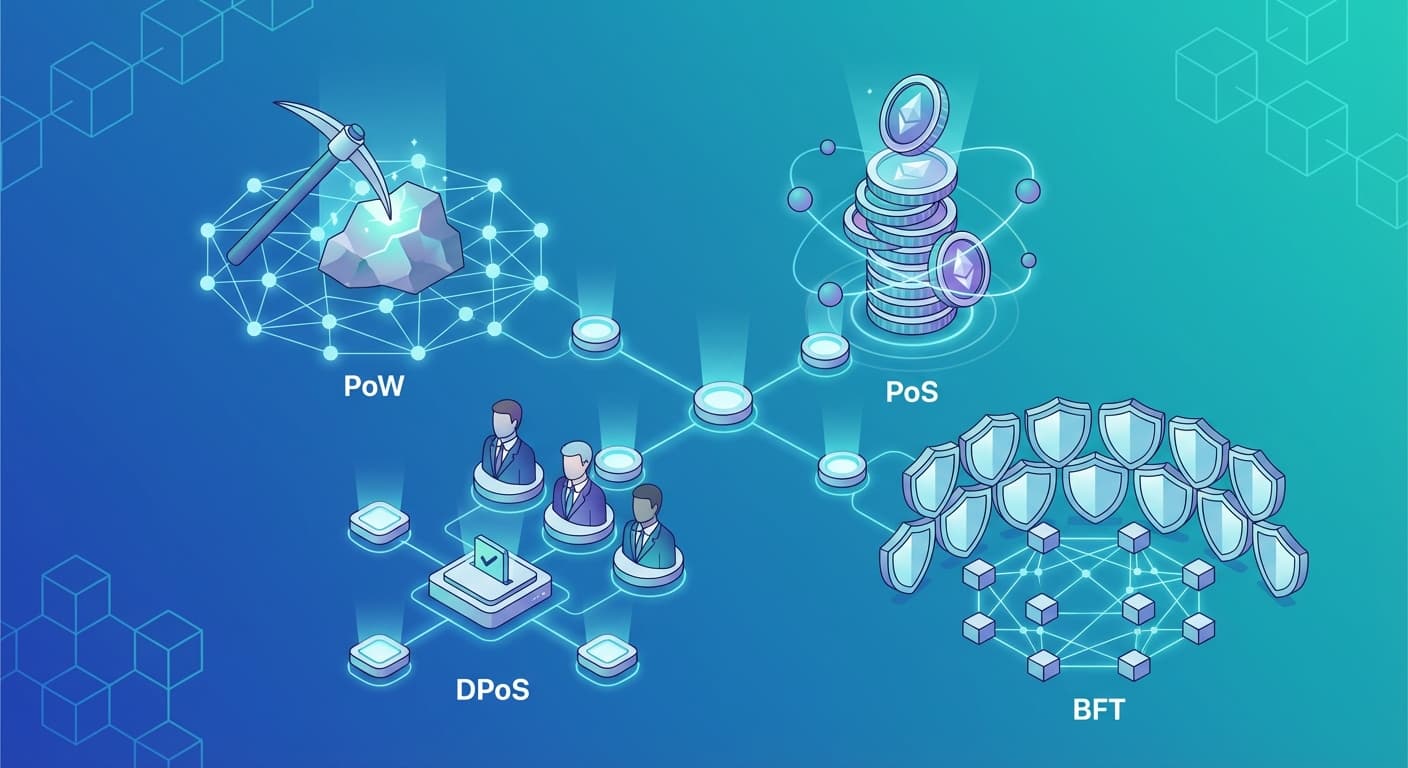
Consensus Algorithms Explained: PoW vs PoS vs DPoS
Learn how blockchain consensus algorithms work — from Proof of Work to Proof of Stake, DPoS, BFT, and PoH. Compare trade-offs, real-world use cases, risks, and what it all means for your gas fees and staking activity.
GOMTU9 min read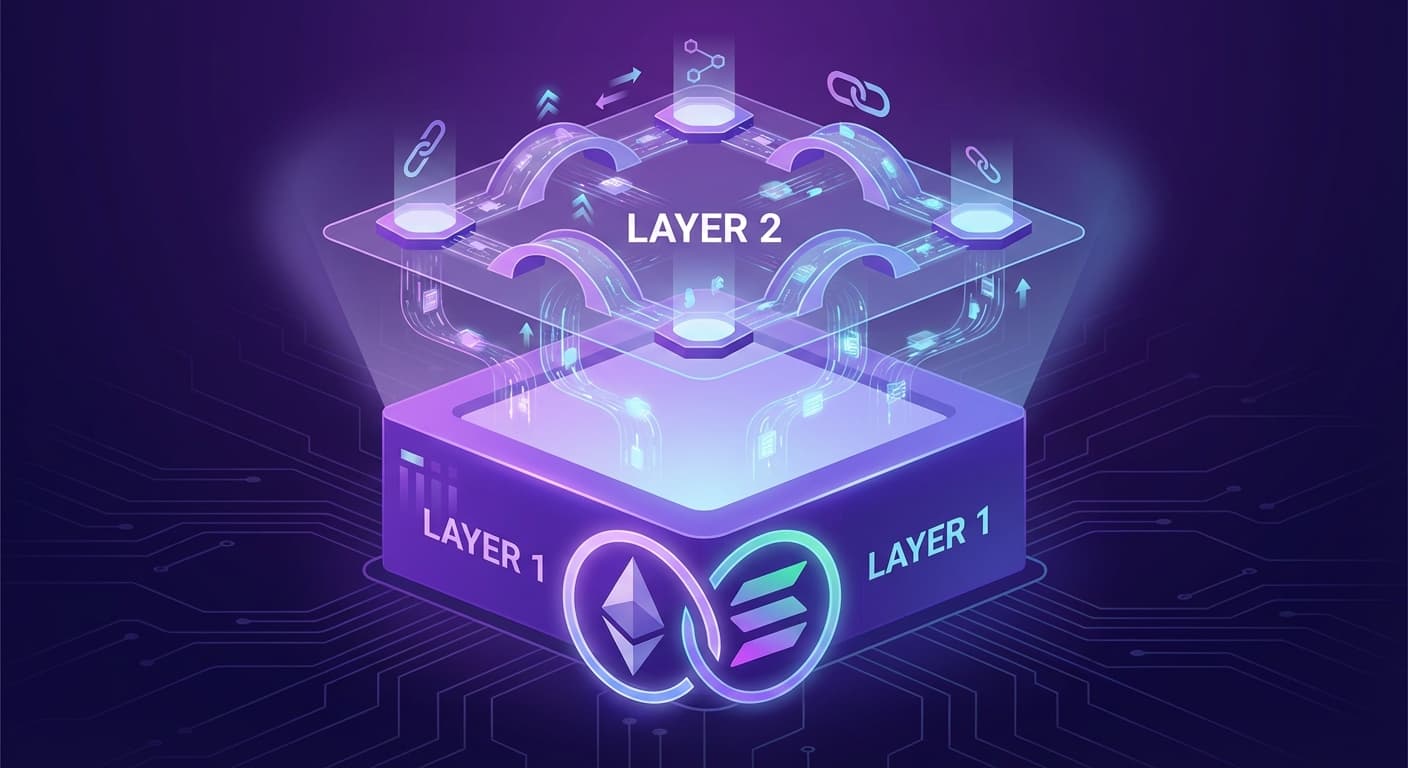
Layer 1 vs Layer 2: Key Differences, When to Use Each, and Top Projects
Not sure whether to use Layer 1 or Layer 2? Compare L1 vs L2 blockchains — rollup types, costs, speed, risks, and which chain fits your use case in 2026.
GOMTU9 min read
Gas Fees Explained: A Complete Guide to Blockchain Transaction Costs
Learn how blockchain gas fees work, what drives costs up or down, practical tips to save on every transaction, and the risks every user should understand.
GOMTU9 min read
What Are Smart Contracts? How They Work and Real Use Cases
Discover what smart contracts are, how they work on the blockchain, and their real-world use cases in DeFi, NFTs, and RWA — plus risks, limits, and FAQ.
GOMTU7 min read