Ethereum Account Nonce Explained: Order, Replay Protection, and RPC
Learn how an Ethereum account nonce orders transactions, blocks replay, creates queue gaps, and changes how developers query pending account state.

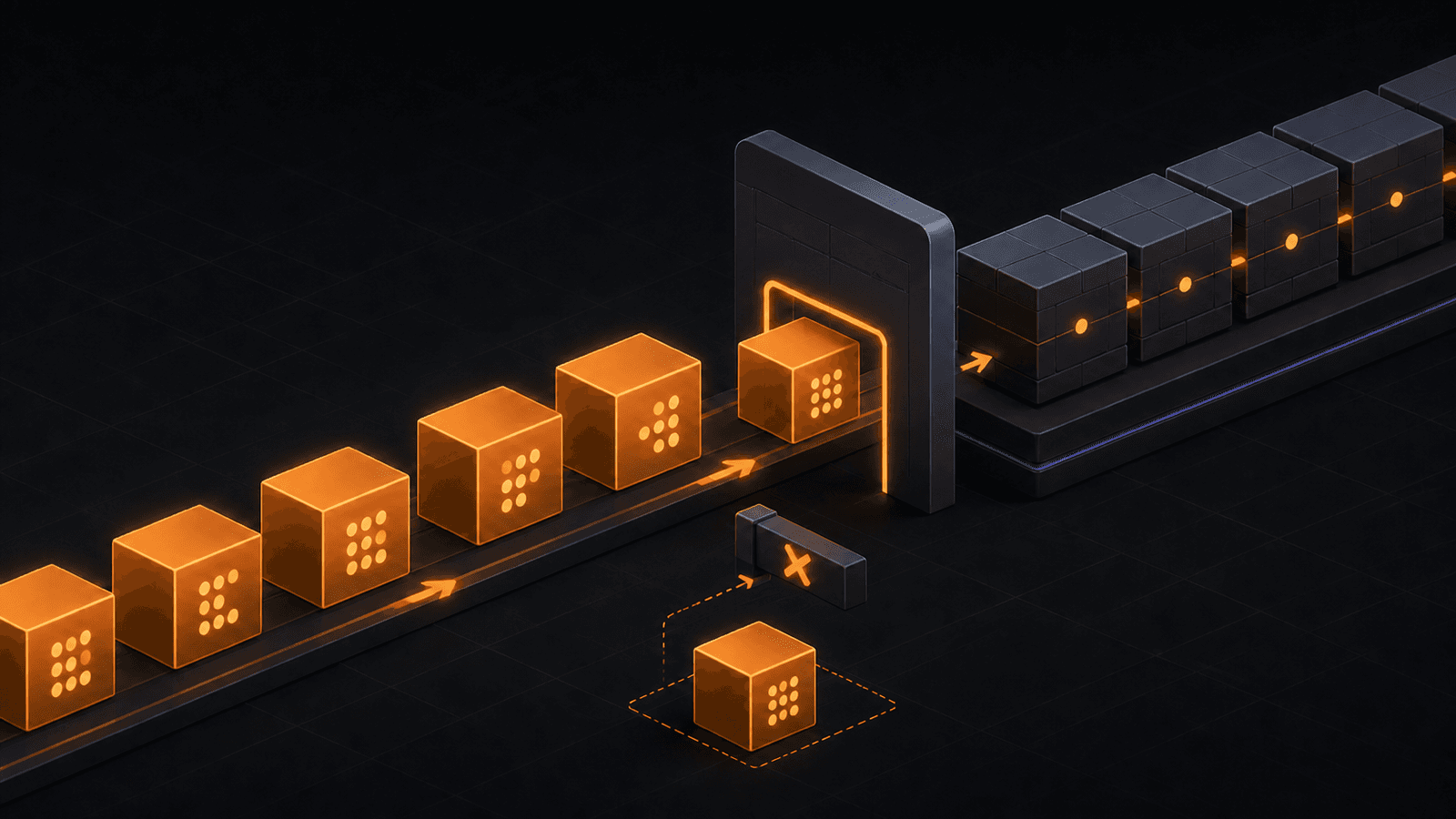
If you have ever sent two Ethereum transactions quickly and watched the second one wait, the account nonce is probably the quiet rule controlling the queue. It is a small integer with an outsized job: it gives transactions from one account a strict order. That ordering is part of the blockchain basics that wallets usually hide—until a transaction becomes stuck or a developer sends requests concurrently.
This guide explains the protocol-level account nonce, not the random nonce used inside some cryptographic signatures and not Bitcoin mining's proof-of-work nonce. We will follow the value from wallet to mempool to block, then turn the model into practical RPC and troubleshooting rules.
What is an Ethereum account nonce?
For a conventional externally owned account (EOA), the nonce is a counter stored in Ethereum state. A transaction from that account includes a nonce, and the valid next transaction uses the account's current value. Once that transaction executes, the state advances.
Think of a bakery ticket dispenser. Ticket 42 must be served before ticket 43. A customer can prepare several orders, but skipping 42 does not make 43 the next valid order. Ethereum applies that sequencing independently to each sending account.
The official Ethereum accounts documentation says only one transaction with a given account nonce can execute. This provides two linked properties:
- Ordering: transactions from one sender cannot execute in an arbitrary sequence.
- Replay protection: a signed transaction whose nonce has already been consumed cannot be executed again from that account on the same chain state.
The nonce is not a global transaction number. Alice's nonce 12 and Bob's nonce 12 are unrelated because each account maintains its own state.
How nonce ordering works
Suppose an account's next valid nonce is 7.
| Submitted transaction | What a node can do |
|---|---|
| Nonce 6 | Reject it as already used or too low |
| Nonce 7 | Treat it as the next executable transaction if all other checks pass |
| Nonce 8 | Hold it as a future transaction until nonce 7 is resolved |
| Another nonce 7 | Treat it as a competing replacement candidate under local pool rules |
This distinction matters: valid for the future is not the same as executable now. Geth separates executable pending transactions from queued transactions with nonce gaps. Its txpool documentation also notes that a pool may know multiple transactions from the same account with the same nonce, often carrying different fee settings. Only one can ultimately consume that nonce in canonical state.
Nodes have local mempools, not one universal Ethereum waiting room. Two RPC providers can temporarily see different pending candidates. Consensus determines what enters the chain; a particular node's pool policy determines what it stores and relays before inclusion.
Why a nonce prevents transaction replay
A signature proves authorization, but authorization alone does not say whether the instruction is new. Without a consumed sequence value, someone could rebroadcast an old signed payment and ask the network to execute it again.
The account nonce acts like a one-use claim check. The signature commits to the transaction fields, including the nonce. After nonce 7 is consumed, another transaction from that sender carrying nonce 7 no longer matches the account's required next value. Repeating the exact signed bytes does not reset the counter.
This account-level mechanism should not be confused with chain-level replay protection. Chain identifiers in signed Ethereum transactions help prevent a transaction intended for one chain from being replayed on another compatible chain. The account nonce and chain ID solve related but different replay problems.
Nonce gaps, replacements, and stuck queues
Nonce sequencing explains three common wallet symptoms.
A higher nonce is queued
If nonce 21 is missing while 22 and 23 are broadcast, later transactions cannot jump ahead. The sender must get a valid transaction with nonce 21 included, replace an existing nonce-21 candidate, or wait for local pool state to change before rebuilding the sequence.
Two transactions share a nonce
They are alternatives, not two ordered jobs. Wallet “speed up” and “cancel” features generally create a new transaction using the same nonce with fee settings intended to satisfy the connected node's replacement policy. A cancellation does not erase a signed transaction; it tries to get a different same-nonce transaction included first.
A nonce is too low
This usually means the node believes canonical or pending state has already moved past the supplied value. Before retrying, compare the correct account, chain, confirmed state, and pending state. Blindly incrementing until an RPC accepts a transaction can create unintended transfers or contract calls.
Reading the nonce with JSON-RPC
Ethereum's standard method is eth_getTransactionCount. Despite its historical name, the current Execution API specification defines the result as the account nonce. It also warns that, after Pectra and EIP-7702, the nonce is no longer always equivalent to a simple count of transactions sent.
{
  "jsonrpc": "2.0",
  "method": "eth_getTransactionCount",
  "params": ["0xYourAddress", "pending"],
  "id": 1
}
The result is a hexadecimal unsigned integer. For example, 0x2a is decimal 42.
The block parameter changes the question:
latestasks for the nonce in the latest canonical block observed by that node.pendingasks against a sample pending block assembled from the node's local pool.- A specific block number or hash asks for historical state at that point, if the provider serves it.
For constructing the next transaction, developers often consider pending, but it is not a concurrency lock. Two workers can read the same value before either broadcasts. Production senders need a nonce manager: serialize transaction creation per account, reserve nonces atomically, record signed payloads, reconcile receipts, and recover deliberately from dropped transactions.
The post-Pectra detail developers should know
It was once convenient to describe an EOA nonce as “the number of transactions sent.” That shortcut is now unreliable. EIP-7702 authorization processing can increment an authority account's nonce, so the official API explicitly calls the returned value the account nonce, not a guaranteed sent-transaction count.
The practical rule is simple: query and manage the protocol state you need. Do not reconstruct the next nonce by counting explorer rows. Explorers may omit dropped transactions, classify internal calls differently, or display activity that does not correspond one-for-one with account nonce changes.
At the protocol boundary, finalized EIP-2681 limits the account nonce and makes a transaction invalid when its nonce is greater than or equal to 2^64 - 1. Normal users will never approach that ceiling; its value is a precise bound for clients and proof formats.
Safe implementation checklist
For wallet users:
- Confirm the sender address and network before comparing nonce values.
- Find the lowest unresolved nonce rather than acting on the newest queued transaction.
- Use the wallet's documented replacement flow instead of editing raw fields you do not understand.
- Recheck onchain status immediately before signing a replacement.
For developers:
- Maintain one coordinated nonce allocator per sender account.
- Treat
pendingas one node's view, not a network-wide promise. - Persist transaction hashes, nonces, raw signed transactions, and intended actions together.
- Reconcile against receipts and canonical account state after restarts or provider changes.
- Never reuse a nonce for two business actions unless one is intentionally replacing the other.
When diagnosing results, a transaction receipt tells you whether an included transaction succeeded, while Ethereum calldata helps you identify what contract action was authorized. The nonce answers a different question: where did this sender's instruction belong in sequence?
Risks and limits
Manual nonce control can be expensive and irreversible. A same-nonce replacement may execute a different action than you intended. A higher-nonce transfer may become executable later, after you have forgotten it. Provider disagreement can make a dropped transaction appear alive—or a live candidate appear missing. Smart-account systems can also define richer nonce schemes than the classic single EOA counter.
Do not share a seed phrase or private key with anyone offering to “fix” a nonce. A legitimate support agent does not need custody of your keys. Test custom transaction infrastructure on a test network, use small amounts when moving real assets, and verify current wallet and client documentation.
FAQ
Does every Ethereum transaction have a unique nonce?
The nonce is unique in the execution history of a particular sender. Different accounts can use the same number. Several pending candidates can also share one sender-and-nonce pair, but only one can consume it in canonical state.
Can nonce 12 execute before nonce 11?
Not for the same conventional EOA. A node may store nonce 12 as queued, but it cannot execute until the account state advances through nonce 11.
Is eth_getTransactionCount an exact count of sent transactions?
No. The method returns the account nonce. The name is historical, and post-Pectra EIP-7702 behavior makes the simple transaction-count interpretation unsafe.
Should an application always use pending?
Not blindly. It can help reveal locally pending transactions, but it reflects one node's pool and does not prevent concurrent callers from choosing the same nonce. Use coordinated nonce management and reconciliation.
Is an Ethereum nonce the same as a Bitcoin mining nonce?
No. Ethereum's account nonce sequences a sender's transactions. A proof-of-work mining nonce is varied while searching for a block hash meeting a difficulty target.
The useful mental model
An Ethereum account nonce is a per-sender queue position and one-use replay guard. The next value can execute; future values wait; a consumed value cannot execute again; and same-nonce transactions compete as alternatives. That model is enough to explain most “queued,” “nonce too low,” and replacement behavior without treating a wallet as a black box.
This article is educational, not financial advice. Onchain actions may be irreversible, fees and wallet behavior can change, and mistakes can cause permanent loss. Verify current official documentation, test unfamiliar workflows with amounts you can afford to lose, and do your own research (DYOR).
Keep learning

Pending Ethereum Transactions: Diagnose, Speed Up, or Cancel Safely
Learn why an Ethereum transaction stays pending, how nonce order and fees affect it, and when speeding up, canceling, or waiting is the safest response.
 GOMTU7 min read
Ethereum Transaction Receipts Explained: Status, Gas, Logs, and Proofs
Learn how Ethereum transaction receipts record execution status, gas used, logs, contract creation, typed transactions, and receipt-root commitments.
GOMTU7 min read
Ethereum Calldata Explained: How to Decode Transaction Input Data
Learn how Ethereum calldata encodes function selectors and arguments, how explorers decode it, and what to verify before signing a contract transaction.
GOMTU6 min readExplore related topics

Ethereum Glamsterdam Upgrade: ePBS, BALs, and What Is Actually Planned
Ethereum Glamsterdam is expected in Q4 2026. Learn its frozen scope, Sepolia milestone, ePBS, block-level access lists, and remaining uncertainties.
GOMTU7 min readCrypto Address Poisoning: How to Verify Wallet Addresses Before You Send
Crypto address poisoning plants a lookalike address in your transaction history. Learn how it works and follow a safer verification checklist.
GOMTU7 min read