Cross-Chain Intents Explained: How ERC-7683 Solvers Work
Cross-chain intents let you request an outcome instead of choosing every bridge step. Learn how solvers, resolvers, settlement, and ERC-7683 work.


Moving assets between chains often feels like planning a trip with three separate tickets: pick a bridge, obtain destination gas, wait for settlement, then make the swap you wanted in the first place. Cross-chain intents try to hide that route planning. You state the outcome, while specialized executors compete to deliver it. That is a useful extension of blockchain infrastructure, but convenience does not erase bridge, solver, or settlement risk.
This guide explains the intent model, the current draft of ERC-7683, and the checks you should still make before signing. It describes infrastructure, not an investment strategy.
Not financial advice (NFA). Cross-chain systems can fail through contract bugs, compromised dependencies, bad quotes, or operational outages. Test with an amount you can afford to lose and do your own research (DYOR).
What Is a Cross-Chain Intent?
A normal transaction is prescriptive: call this contract, on this chain, with these parameters. An intent is declarative: deliver this asset to this recipient on that chain, subject to my limits.
Think of the difference between driving with turn-by-turn instructions and telling a courier, “Deliver this package to Seoul by Friday for no more than this fee.” You define the acceptable result. The courier chooses the route.
In crypto, that courier is commonly called a solver, filler, or relayer. A user may request, for example:
- exchange token A on an origin chain for at least a stated amount of token B on a destination chain;
- deliver before a deadline;
- send the output to a specific destination address; and
- optionally execute another destination-chain action.
The Ethereum Foundation describes intents as high-level outcomes that avoid prescribing low-level calls. It also warns that solver intermediaries can introduce trust, censorship, and privacy concerns. That tension—better usability with new dependencies—is the right frame for evaluating them.
How the Intent Lifecycle Works
Interfaces differ, but a simplified lifecycle has five parts.
- You define constraints. The application constructs an order containing the desired output, recipient, chains, deadline, and other limits.
- You authorize the order. Depending on the protocol, this may involve a signature, token approval, permit, or origin-chain deposit.
- Solvers evaluate it. Solvers estimate execution cost, liquidity, timing, and payment. Competitive systems may compare several possible fills.
- A solver executes. The solver supplies destination liquidity or performs the required calls, then proves or records fulfillment through the protocol’s settlement design.
- Settlement pays the solver. The solver recovers capital and receives its payment after the relevant conditions are satisfied.
This “fill first, settle later” experience can feel fast because the solver fronts destination liquidity. It does not mean the underlying chains reached instant blockchain finality. User delivery, solver reimbursement, and final settlement can occur on different timelines.
What ERC-7683 Standardizes
ERC-7683 is a draft Ethereum standard for a solver-facing interface. Its current design lets an intent protocol expose its own order payload and provide a resolver that translates that payload into a common representation solvers can inspect.
That boundary matters. ERC-7683 does not force every protocol to use the same user interface, escrow contract, auction, price mechanism, or settlement contract. Instead, it aims to give solvers a shared language for evaluating:
- the steps they must execute;
- variables and dependencies between those steps;
- assets, allowances, recipients, timing bounds, and gas requirements;
- conditions under which execution may revert or abort; and
- the payments expected after particular steps.
The current specification depends on ERC-7930 interoperable addresses, a binary format that identifies both an address and its chain. That prevents an otherwise ambiguous address from being interpreted on the wrong network and allows the order model to refer beyond one EVM chain.
Important
Many older ERC-7683 summaries describe an earlier CrossChainOrder interface and common settlement flow. The live draft has moved toward protocol-specific payloads resolved into common solver instructions. Always check the current specification rather than assuming an old explainer is still accurate.
What ERC-7683 Does Not Guarantee
A standard interface is not a security certificate.
The ERC’s own security section says it does not guarantee the safety of the settlement protocol. A resolver can describe steps, payments, and assumptions, but safety still depends on the resolver implementation, contracts, tokens, chain conditions, and any offchain or cross-chain systems involved.
ERC-7683 also does not guarantee:
- that your quote is the best available;
- that enough solvers will compete for every route;
- that a solver cannot censor or decline an order;
- that the destination chain will remain live;
- that the application’s frontend is authentic;
- that token approvals are narrowly scoped; or
- that a bridge or verification mechanism cannot be exploited.
Across documents a production implementation through its AcrossOriginSettler, which validates parameters and creates deposits in its own contracts. That is evidence the intent pattern can be implemented, not evidence that every ERC-7683-compatible system shares Across’s architecture or risk profile.
Intents vs Traditional Bridges
| Question | Traditional bridge flow | Intent-based flow |
|---|---|---|
| What do you specify? | A particular transfer route | An acceptable outcome and constraints |
| Who finds the route? | Usually you or an aggregator | A solver network or routing system |
| Destination liquidity | Often released after verification | May be fronted by a solver |
| User experience | Multiple explicit steps may be visible | Often presented as one signed action |
| Main risks | Bridge contracts and verification model | Those risks plus solver, auction, and order assumptions |
The categories overlap. An intent protocol still needs some way to move information or settle value across chains. It may use liquidity pools, canonical bridges, messaging systems, resource locks, or other mechanisms underneath. “Intent-based” describes how the desired outcome is expressed and fulfilled; it does not tell you the full trust model.
For the broader architecture, see our Layer 1 vs Layer 2 guide and modular blockchain explainer.
Risks and Failure Modes
Solver concentration and censorship
If only a few well-capitalized solvers can serve a route, competition may be weak. A solver can ignore orders it considers unprofitable, while a centralized order feed can influence which solvers see them.
Quote and execution risk
Your protection comes from explicit constraints: minimum output, maximum input, deadline, recipient, and permitted actions. A vague or excessively permissive order can produce an outcome you did not expect even if the protocol follows it correctly.
Settlement and finality risk
A solver may deliver quickly but wait longer for reimbursement. Reorganizations, delayed messages, disputed fills, or chain outages can affect that settlement window. Users should not equate a fast interface update with irreversible finality.
Smart-contract and resolver risk
Resolvers and settlement contracts are code. Incorrect dependency rules, unsafe permissions, upgrade keys, or undisclosed assumptions can expose users or solvers. Audits reduce uncertainty but do not eliminate bugs.
Approval and signature risk
A familiar-looking intent can still request a broad token approval or malicious signature. Verify the chain, asset, amount, recipient, deadline, and spender. If the wallet cannot explain what you are signing, stop.
A Practical Pre-Sign Checklist
- Open the application from a verified official source, not a sponsored search result or direct message.
- Confirm origin chain, destination chain, input asset, output asset, and recipient.
- Read the minimum received, total fee, price impact, and deadline.
- Check whether the action requests a one-time amount or unlimited token approval.
- Identify the protocol’s settlement and verification model; “ERC-7683 compatible” is not enough.
- Look for audits, bug disclosures, upgrade controls, and an emergency response process.
- Test a small transfer before committing a meaningful amount.
- Save the order or transaction identifier so you can inspect both chains.
Frequently Asked Questions
Is an intent the same as a transaction?
No. A transaction specifies an action to execute. An intent specifies an acceptable outcome and constraints; a solver chooses how to satisfy them.
Is ERC-7683 finalized?
No. As of July 26, 2026, the official EIP page labels ERC-7683 as a draft. Implementations and articles may reflect different revisions, so check the live specification.
Do intents remove bridges?
Not necessarily. They can hide route selection from the user, but settlement still needs cross-chain infrastructure or liquidity. The underlying bridge, messaging, or verification assumptions remain relevant.
Why would a solver fill my order?
The order offers payment if its requirements are fulfilled. A solver evaluates whether expected payment exceeds execution, liquidity, gas, and risk costs.
Are intent-based transfers safer?
They can reduce user mistakes by simplifying routes, but add solver and order-system assumptions. Safety depends on the complete implementation, not the word “intent.”
Wrapping Up
Cross-chain intents replace route instructions with outcome constraints. Solvers handle execution, while resolver-based standards such as draft ERC-7683 aim to let solvers interpret different protocols through a common interface.
That can make a fragmented multichain environment easier to use. It does not make it trustless by default. Before signing, inspect the constraints, approvals, settlement path, finality assumptions, and protocol-specific risks. Treat speed as a usability feature—not proof of safety.
Note
This article is educational and does not constitute financial advice. Cross-chain protocols and draft standards evolve, and digital assets can lose substantial value. Verify current primary documentation, test with limited funds, and do your own research (DYOR). NFA.
Keep learning

Modular Blockchains Explained: Rollups, Data Availability, and the New Stack (2026)
What is a modular blockchain, and why did the industry pivot to it? A plain-English guide to the four layers, Celestia vs EigenDA, and the real trade-offs.
 GOMTU10 min read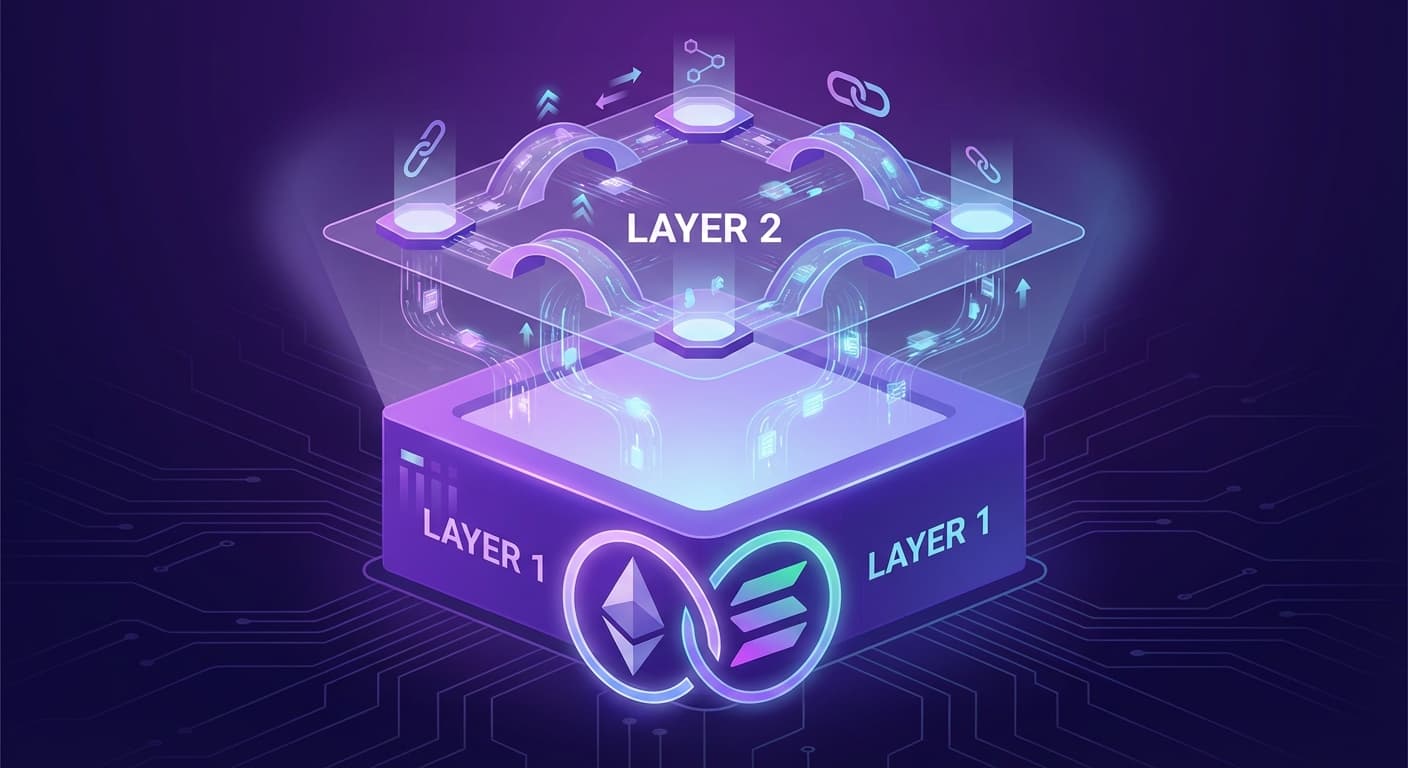
Layer 1 vs Layer 2: Key Differences, When to Use Each, and Top Projects
Not sure whether to use Layer 1 or Layer 2? Compare L1 vs L2 blockchains — rollup types, costs, speed, risks, and which chain fits your use case in 2026.
GOMTU9 min read
Blockchain Finality Explained: When Is a Crypto Transaction Really Settled?
Learn how blockchain finality differs from confirmation, why Bitcoin and Ethereum settle differently, and what to check before moving funds again.
GOMTU7 min readExplore related topics

Cross-Chain Bridge Guide: How to Bridge Safely in 2026 (Step-by-Step)
Learn how to use cross-chain bridges safely: what they are, how lock-and-mint and liquidity pool bridges work, a step-by-step tutorial, and how to avoid the hacks that cost DeFi over $2.8B.
GOMTU9 min read
Crypto Wallet Security: Your Complete Hub for Keys, Scams & Safe Custody
Everything you need to know about crypto wallet security — seed phrases, smart wallets, bridge risks, and scam prevention. Your gateway to staying safe on-chain.
GOMTU11 min read