Layer 1 vs Layer 2: Key Differences, When to Use Each, and Top Projects
Not sure whether to use Layer 1 or Layer 2? Compare L1 vs L2 blockchains — rollup types, costs, speed, risks, and which chain fits your use case in 2026.

Last updated
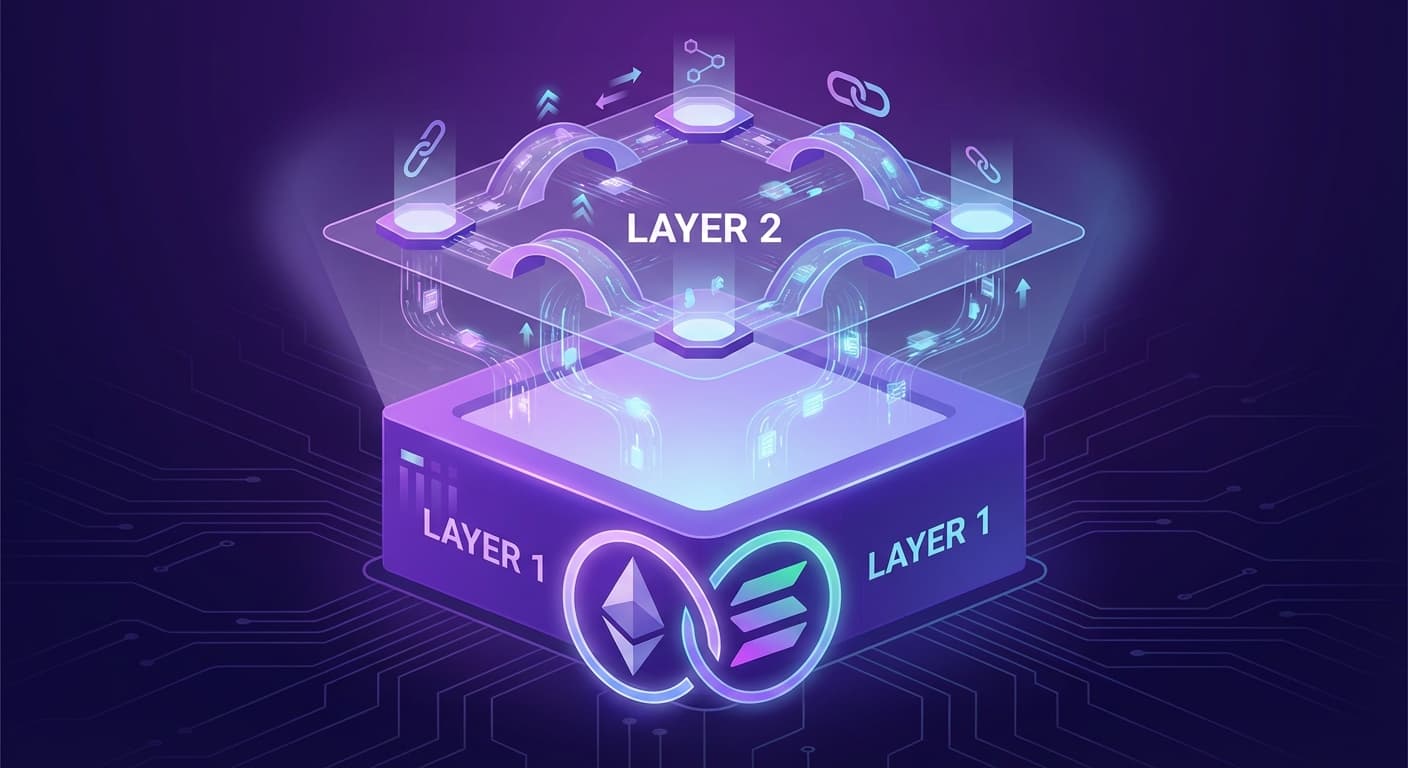
You've seen "Layer 1" and "Layer 2" tossed around in every crypto conversation — but what actually separates them, and does it matter which one you use? If you've ever paid $30 to swap tokens on Ethereum and then saw someone do the same trade on Base for a fraction of a cent, you've already felt the gap firsthand. This guide from the blockchain basics series breaks down how L1 and L2 differ, how the underlying tech works, and — most importantly — which one fits your situation right now.
What Are We Comparing?
Layer 1 (L1) is a base blockchain network that stands on its own. Layer 2 (L2) is a separate network built on top of an L1 — it handles transactions faster and cheaper, then settles the final result back to the base chain.
Think of them less as rivals and more as teammates with distinct roles. The key questions: how do they work differently, what trade-offs do you accept with each, and when does one clearly beat the other?
Layer 1 — The Base Chain
A Layer 1 is a fully independent blockchain that runs its own consensus algorithm, validates its own transactions, and produces its own blocks. No other chain needs to exist for it to function.
The highway analogy. Picture L1 as a main four-lane highway. Traffic flows fine at low volume, but when usage spikes — think the 2021 NFT boom — lanes fill up, speeds drop, and toll costs (gas fees) shoot through the roof. Ethereum at that peak was the highway at rush hour: simple token swaps cost hundreds of dollars.
- Validates and settles transactions directly
- Secures its own network without outside help
- Fully independent — no dependency on another chain
- Examples: Bitcoin, Ethereum, Solana, BNB Chain, Avalanche
Layer 2 — The Scaling Solution
A Layer 2 is built on top of a Layer 1. It processes transactions off-chain in bulk, then compresses and posts the results back to L1 periodically. It offloads the L1's burden while inheriting its security guarantees.
The express rail analogy. L2 is a high-speed rail line running above that highway. Passengers (transactions) board the express train — fast and cheap — and the final check-in happens at the destination (L1). The highway still handles ultimate accountability; the rail handles the volume.
- Inherits L1 security without bearing the full cost of running on L1
- Dramatically higher throughput, dramatically lower fees
- Settles batches to L1, not individual transactions
- Examples: Arbitrum, Base, Optimism, zkSync Era, Starknet
Head-to-Head: L1 vs L2
| Aspect | Layer 1 (Ethereum) | Layer 2 (Arbitrum, Base, etc.) |
|---|---|---|
| TPS | ~30 | ~2,000–4,000 |
| Typical fee | $0.01–$0.50 | $0.001–$0.05 |
| Transaction finality | ~12 minutes | Seconds |
| Security model | Self-secured (1M+ validators) | Inherited from L1 |
| Decentralization | High | Dependent on L1 |
| Independence | Fully independent | Relies on L1 for settlement |
| Best for | Large fund movements, maximum security | Daily trades, DeFi, NFTs |
Note
The Blockchain Trilemma — the trade-off between security, decentralization, and scalability — is why L1s like Ethereum cap at ~30 TPS. L2s sidestep that cap by doing computation off-chain while L1 handles final verification.
How Layer 2 Works: Rollups
As of 2026, most L2s use rollup technology. A rollup bundles hundreds or thousands of transactions into one compressed batch and posts that batch to L1 — splitting the L1 cost across every transaction in the bundle. Two main designs exist, and choosing between them comes with real trade-offs.
Optimistic Rollups — "Trust first, prove fraud if needed"
- Transactions execute on L2
- Results are submitted to L1 — assumed valid by default
- A 7-day challenge period begins
- If anyone detects fraud, they submit a fraud proof
- Invalid transactions are reversed; the bad actor is penalized
Pros: High EVM compatibility — existing DApps port over without major rewrites. Fees are very low.
Cons: Moving funds back to L1 via the official bridge takes up to 7 days.
Key projects: Arbitrum, Base, Optimism
ZK Rollups — "Prove mathematically, confirm instantly"
- Transactions execute on L2
- A zero-knowledge proof is generated — mathematically verifying every transaction's validity
- The proof and compressed data post to L1 — confirmed immediately
- No challenge period required
Pros: Near-instant L1 withdrawal. Theoretically stronger cryptographic security model.
Cons: Proof generation adds computational overhead. EVM compatibility is still maturing across projects.
Key projects: zkSync Era, Starknet, Polygon zkEVM, Scroll
Optimistic vs ZK: Side by Side
| Aspect | Optimistic Rollup | ZK Rollup |
|---|---|---|
| Verification | Fraud proof (challenge period) | Validity proof (cryptographic math) |
| L1 withdrawal time | ~7 days (or fast bridge fee) | Minutes to hours |
| EVM compatibility | High | Improving rapidly |
| TVL (approx.) | ~$186B combined | ~$20B combined |
| Cost profile | Very low | Low (proof generation cost exists) |
| Leading projects | Arbitrum, Base, Optimism | zkSync Era, Starknet |
Tip
Need to move large funds back to Ethereum L1 quickly from an optimistic rollup? Fast bridge services like Across or Hop can settle in minutes — but they charge a fee and add another smart contract to trust. If you withdraw to L1 frequently, a ZK rollup may be worth evaluating for that specific use case.
Top L2 Projects at a Glance (2026)
| Project | TVL (approx.) | Daily TXs | Rollup Type | Standout Feature |
|---|---|---|---|---|
| Arbitrum | ~$16.6B | 2M+ | Optimistic | Largest L2 DeFi ecosystem; Stylus (Rust/C++ contracts) |
| Base | ~$10B | 3M+ | Optimistic (OP Stack) | Coinbase integration; fastest growth 2025–2026 |
| Optimism | ~$6B | 1M+ | Optimistic | OP Stack powers Base, Worldcoin, Zora (Superchain) |
| zkSync Era | ~$1B | — | ZK | Native account abstraction; no 7-day withdrawal delay |
TVL figures change frequently — verify on L2Beat or DeFiLlama before making any decisions. This is not an endorsement of any project.
Who Should Use What, and When?
Real-world cost comparison (March 2026):
| Operation | Ethereum L1 | Arbitrum | Base |
|---|---|---|---|
| ETH transfer | ~$0.10 | ~$0.008 | ~$0.01 |
| DEX swap | ~$0.30 | ~$0.03 | ~$0.03 |
| NFT mint | ~$0.50 | ~$0.05 | ~$0.05 |
Use Ethereum L1 when: you're moving a large amount where the security premium justifies the fee, or when the protocol you need only exists on L1.
Use Arbitrum when: you're active in DeFi — GMX, Aave, Uniswap — and want the broadest L2 protocol selection.
Use Base when: you're onboarding from Coinbase, exploring social DApps, minting NFTs, or farming airdrops. Easiest entry point for newcomers.
Consider ZK rollups when: you need faster L1 withdrawals and can accept a smaller ecosystem at this stage of development.
Consider Solana when: you want ultra-low-cost transactions on a high-performance L1 outside the Ethereum ecosystem. Note: Solana is an independent L1, not an Ethereum L2.
Note
EIP-4844 (blob transactions), introduced in early 2024, cut L2 data costs by over 97% — dropping average L2 fees from cents to fractions of a cent. This single upgrade is still the biggest factor keeping L2 fees low throughout 2026.
Risks and What to Watch
Bridge Risk
Moving assets between L1 and L2 requires a bridge. Bridges are among the most frequently exploited components in crypto — cross-chain bridge hacks have resulted in billions of dollars in losses.
- Always use official bridges (Arbitrum Bridge, Base Bridge, etc.)
- Split large transfers across multiple smaller transactions to limit exposure
- For third-party bridges, stick to audited, reputable protocols (Across, Stargate) and check audit dates
Warning
Never use a bridge you found through a social media ad, an anonymous DM, or a newly launched protocol with no audit history. The more attractive the promoted yield, the more skeptical you should be.
Withdrawal Delays (Optimistic Rollups)
The 7-day challenge window is a real constraint. If you need funds sooner, fast bridge services are available — but factor in their fee and understand you're trusting an additional smart contract in that transaction.
Liquidity Fragmentation
The same token exists across multiple L2s with different liquidity depths. Swapping on a lower-liquidity chain can produce higher slippage than you expected. Understanding AMM mechanics and liquidity pools helps you navigate this confidently.
Sequencer Centralization
Most L2s today rely on a single sequencer — usually operated by the L2 team — to order and batch transactions. If that sequencer goes offline or censors a transaction, it affects your activity on that L2, even though your funds are ultimately secured by L1. You can always exit to L1 via the official bridge, but this centralization remains an open problem as of 2026. Decentralized sequencer designs (including Based Rollups, which delegate sequencing to Ethereum validators) are under active research.
FAQ
Q: Is my money on an L2 as safe as on Ethereum L1?
L2 assets are backed by L1 settlement, so the cryptographic security of Ethereum ultimately protects them. However, the bridge contract and sequencer introduce additional risk layers that don't exist when you hold assets directly on L1. How safe it is depends heavily on which bridge you use and whether the L2 and its contracts have been audited. Do your own research before bridging significant amounts.
Q: Can I use MetaMask on Layer 2?
Yes. Arbitrum, Base, and Optimism all support MetaMask and any EVM-compatible wallet. You'll need to add the network manually or let a DApp prompt the addition automatically. ZK rollups like zkSync Era also support MetaMask.
Q: What is a sequencer, and why does it matter?
A sequencer orders and batches transactions before posting them to L1. Most L2s currently run a centralized sequencer. If it goes offline or delays your transaction, you may experience slowdowns — though you can always force-exit to L1 via the official bridge. Decentralized sequencer designs are being developed, but this remains a meaningful risk today.
Q: Why did my L2 withdrawal take more than 7 days?
Seven days is the standard for direct optimistic rollup withdrawals via the official bridge. Network congestion, bridge UI issues, or using a non-standard path can extend the wait. Fast bridges (Across, Hop) skip the 7-day window but charge a fee. ZK rollup withdrawals typically complete in minutes to a few hours.
Q: Do I need to pay gas fees in ETH on every L2?
Most Ethereum L2s — Arbitrum, Base, Optimism — require ETH for gas. Some networks support account abstraction that lets DApps sponsor fees on your behalf, or allow alternative gas tokens. Always check the specific network's documentation rather than assuming ETH is required.
Wrapping Up
L1 and L2 aren't competing — they're dividing labor. Ethereum (L1) provides the security foundation and final settlement; L2s handle the execution volume at a fraction of the cost. As you explore on-chain activity, the right choice usually comes down to two questions: how much security do you need for this specific transaction, and which protocols exist on the chain you're considering?
Start with the blockchain basics to build your foundation, set up a secure crypto wallet before moving any assets, and always verify bridge contracts and audit histories before bridging significant funds.
This article is for informational purposes only and does not constitute financial or investment advice. Any decisions regarding blockchain networks or tokens should be based on your own research and judgment. DYOR. NFA.
Keep learning
Zero-Knowledge Proofs Explained: zk-SNARKs, zk-STARKs & ZK Rollups
Zero-knowledge proofs let you prove something is true without revealing the data. Learn how zk-SNARKs, zk-STARKs, and ZK rollups power privacy and Ethereum scaling.
 GOMTU8 min read
Consensus Algorithms Explained: PoW vs PoS vs DPoS
Learn how blockchain consensus algorithms work — from Proof of Work to Proof of Stake, DPoS, BFT, and PoH. Compare trade-offs, real-world use cases, risks, and what it all means for your gas fees and staking activity.
GOMTU9 min read
What Are Smart Contracts? How They Work and Real Use Cases
Discover what smart contracts are, how they work on the blockchain, and their real-world use cases in DeFi, NFTs, and RWA — plus risks, limits, and FAQ.
GOMTU7 min readExplore related topics
Crypto Wallet Security: Your Complete Hub for Keys, Scams & Safe Custody
Everything you need to know about crypto wallet security — seed phrases, smart wallets, bridge risks, and scam prevention. Your gateway to staying safe on-chain.
GOMTU11 min read
Polkadot Halving 2026: DOT Supply Cap, 53.6% Emission Cut Explained
Polkadot undergoes its first-ever tokenomics overhaul on March 14, 2026 — a 2.1B DOT supply cap, 53.6% emission cut, and staking redesign. Here is what the changes actually mean.
GOMTU8 min read