Ethereum Transaction Gas Limit: How the EIP-7825 Cap Works
Understand Ethereum’s 16,777,216-gas transaction cap, why it differs from the block gas limit, and how developers can handle oversized calls.

Ethereum raised the amount of work a block can carry, but it also put a ceiling on how much of that capacity one transaction may consume. That sounds contradictory until you separate two controls. Blockchain basics explains the shared ledger; this guide zooms in on the guardrail that keeps one unusually large operation from dominating its execution budget.
Since the Fusaka upgrade activated on December 3, 2025, Ethereum mainnet has enforced EIP-7825: a transaction cannot specify a gas limit above 16,777,216 gas, or 2^24. The cap is protocol behavior, not a wallet recommendation and not a forecast of the gas a normal transfer will use.
What the Ethereum Transaction Gas Limit Means
Every Ethereum transaction declares a gasLimit, the maximum amount of computational work the sender authorizes. The EVM charges for gas actually consumed. An out-of-gas execution can spend the gas used before reverting its state changes.
EIP-7825 adds a validity rule before execution. If a transaction's declared gas limit exceeds 2^24, the transaction is invalid. It does not matter whether the code would probably consume less at runtime. The declared ceiling itself must fit.
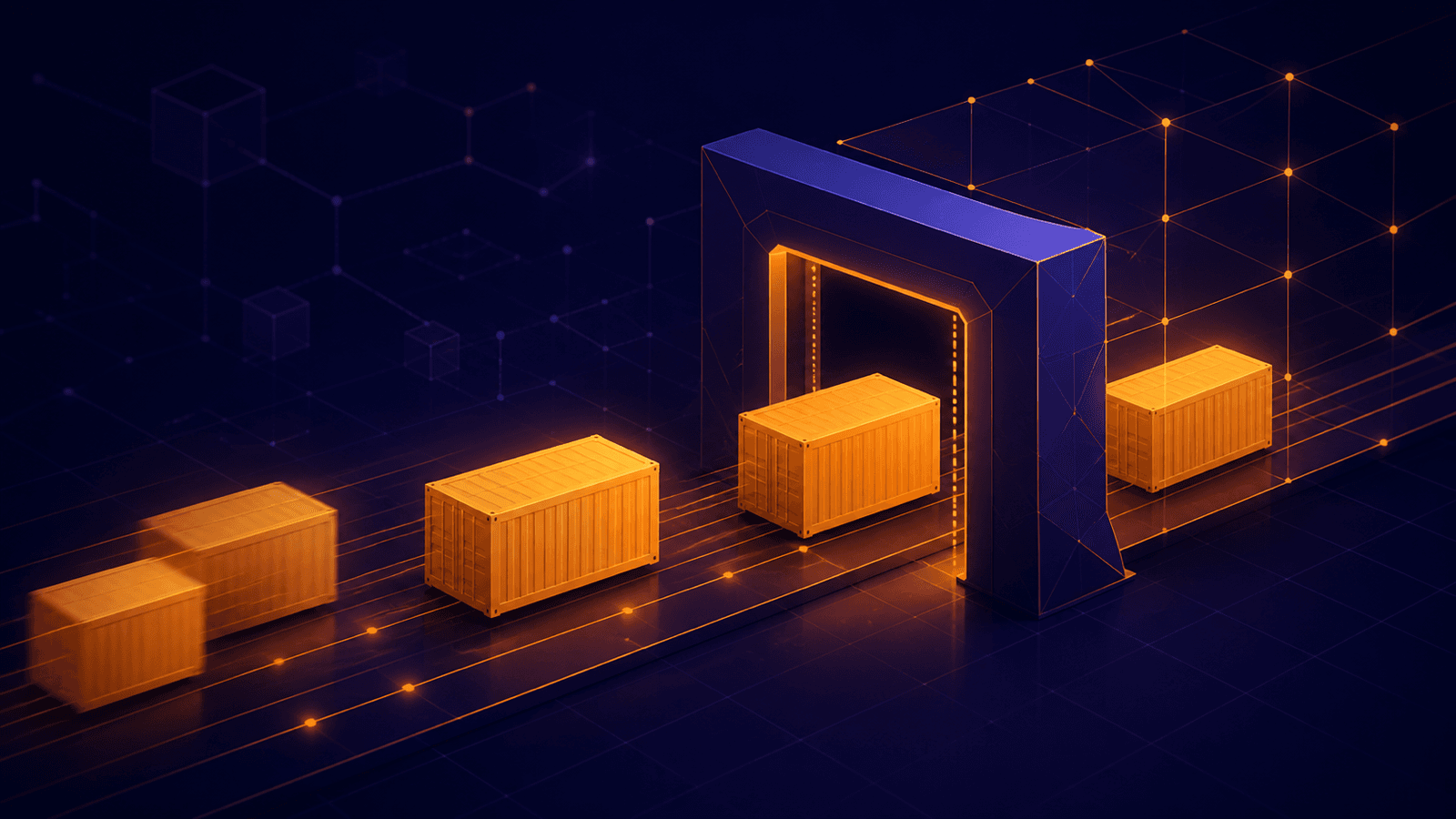
Think of an Ethereum block as a cargo ship and transactions as containers. The block gas limit says how much total cargo the ship can carry. EIP-7825 says no single container may be larger than 16,777,216 units. A larger ship can carry more containers, but operators still reject an oversized container that would be difficult to handle safely.
Transaction Gas Limit vs Block Gas Limit
These limits answer different questions:
| Limit | What it controls | Fusaka-era value | Enforcement |
|---|---|---|---|
| Transaction gas cap | Maximum gas declared by one transaction | 16,777,216 gas | Consensus rules through EIP-7825 |
| Block gas limit | Maximum aggregate execution gas in one block | 60 million was the Fusaka client target | Validators adjust it within protocol bounds |
| Wallet estimate | Expected gas for one call | Varies by call and state | Wallet or RPC simulation |
The cap does not mean each block holds only one 16.7M-gas transaction. A block can include many smaller transactions until their used gas reaches its limit. Nor does a 60M block limit guarantee room for one call: other transactions consume capacity, and builders choose ordering.
This also explains why gas fees are not automatically lower. More block capacity can relieve congestion, but EIP-7825 itself is a safety bound. Your fee still depends on gas used, the base fee, and the priority fee.
Why Ethereum Added EIP-7825
Ethereum's 2026 scaling work aims to move the block gas limit toward and beyond 100M, supported by client benchmarking and protocol changes. Higher capacity creates a risk: without a per-transaction cap, one operation could occupy an increasing share of a block and produce a large worst-case validation workload.
EIP-7825 bounds that workload. The canonical proposal describes the cap as protection against denial-of-service risks and preparation for future parallel execution. Independent transactions may be processed alongside one another, but one enormous serial task remains a bottleneck. Keeping each task bounded makes scheduling and validation easier to reason about.
The number is deliberate. 2^24 is a power of two clients can implement consistently, below the larger block limit but high enough for unusually complex operations. The ethereum.org Fusaka guide says regular user transactions are far from the cap; likely edge cases include large deployments, complex DeFi calls, and broad batch operations.
What Happens When a Transaction Exceeds the Cap
A mainnet transaction with gasLimit > 16,777,216 fails the protocol's validity check and cannot enter a valid block. This differs from an accepted transaction that starts executing and runs out of gas.
- Over the EIP-7825 cap: invalid before EVM execution because the declared limit is too high.
- Within the cap, but underestimates the call: execution can run out of gas and revert state changes while charging for work performed.
- Within the cap and sufficient: execution can succeed, assuming the call does not revert for another reason.
Do not “fix” an estimate by blindly setting the largest value. A sound application simulates the exact call against recent state, adds a measured buffer, and shows the estimate to the signer. State can change before inclusion, so even a good estimate is not a guarantee.
Developer Checklist for Large Calls
Most applications require no migration. Systems that deploy large contracts or batch many actions should use a deliberate test path:
- Estimate on the target chain. Run
eth_estimateGaswith the real sender, destination, value, calldata, and recent state. - Check the declared limit. Reject or split work requiring more than
16,777,216gas on Ethereum mainnet. - Test worst-case branches. A cheap happy path can hide expensive loops, storage writes, proof verification, or first-time initialization.
- Split independent work. Create resumable chunks and idempotent retries so partial execution does not duplicate effects.
- Avoid unbounded loops. User-controlled arrays can make a previously safe method unusable as state grows.
- Monitor receipts. Compare
gasUsedwith estimates and alert before calls approach the cap.
Simulation has an important wrinkle. Ethereum.org states that eth_call is not bound by the consensus transaction cap, although an RPC operator may impose a separate limit. A successful oversized eth_call therefore does not prove that the equivalent transaction is valid on mainnet. Treat simulation as a diagnostic, then enforce the chain rule separately.
If calldata is confusing, decode its function and arguments with the Ethereum calldata guide. You need to know what a batch asks a contract to do before deciding whether to optimize or split it.
Risks and Common Mistakes
- Confusing gas limit with price: gas is work; the fee is gas used multiplied by fee parameters. Raising a limit does not by itself raise the final cost, but failed work can cost money.
- Trusting one simulation: contract state, access patterns, and preceding transactions can change before inclusion.
- Assuming every EVM chain matches Ethereum: rollups and other networks can use different transaction, block, RPC, or batch limits.
- Splitting atomic work carelessly: one transaction is atomic; several are not. Later chunks can fail after earlier chunks succeed.
- Treating capacity as a promise: a valid transaction may wait because of fees, congestion, builder policy, or nonce ordering.
FAQ
Is the limit 16 million or 16,777,216?
The exact cap is 16,777,216, equal to 2^24. “16 million” is shorthand and should not be used in validation code.
Did EIP-7825 lower the block gas limit?
No. It capped individual transactions while Fusaka-era client coordination raised the block gas limit to 60M. They operate at different levels.
Does a simple ETH transfer approach the cap?
No. A plain transfer between externally owned accounts traditionally uses 21,000 gas, far below the cap. Contract behavior can require more.
Can a wallet bypass the cap?
No. Wallet settings cannot override a consensus rule. Oversized work must be optimized or divided into multiple transactions.
Does eth_call guarantee a transaction can be mined?
No. An RPC may simulate a call larger than the cap, and simulation state can differ from inclusion state. Check both execution and validity constraints.
Primary Sources
- EIP-7825: Transaction Gas Limit Cap — canonical specification, motivation, and validity rule.
- Ethereum.org: Fusaka upgrade — activation status, developer impact, and relationship to the 60M block gas limit.
- Ethereum Foundation: Fusaka Mainnet Announcement — activation details and shipped execution-layer changes.
- Ethereum Foundation: Protocol Priorities Update for 2026 — scaling direction toward and beyond a 100M block gas limit.
EIP-7825 is a guardrail for scaling, not a fee discount or investment catalyst. For most users it stays invisible; for developers building unusually heavy calls, it is a hard boundary that belongs in tests and transaction construction. Verify chain-specific rules, test changing state, and do your own research (DYOR). This article is educational and not financial advice (NFA).
Keep learning

Gas Fees Explained: A Complete Guide to Blockchain Transaction Costs
Learn how blockchain gas fees work, what drives costs up or down, practical tips to save on every transaction, and the risks every user should understand.
 GOMTU9 min read
Ethereum Calldata Explained: How to Decode Transaction Input Data
Learn how Ethereum calldata encodes function selectors and arguments, how explorers decode it, and what to verify before signing a contract transaction.
GOMTU6 min read
What Are Smart Contracts? How They Work and Real Use Cases
Discover what smart contracts are, how they work on the blockchain, and their real-world use cases in DeFi, NFTs, and RWA — plus risks, limits, and FAQ.
GOMTU7 min readExplore related topics

Cross-Chain Bridge Guide: How to Bridge Safely in 2026 (Step-by-Step)
Learn how to use cross-chain bridges safely: what they are, how lock-and-mint and liquidity pool bridges work, a step-by-step tutorial, and how to avoid the hacks that cost DeFi over $2.8B.
GOMTU9 min read
Polkadot Halving 2026: DOT Supply Cap, 53.6% Emission Cut Explained
Polkadot undergoes its first-ever tokenomics overhaul on March 14, 2026 — a 2.1B DOT supply cap, 53.6% emission cut, and staking redesign. Here is what the changes actually mean.
GOMTU8 min read