Zero-Knowledge Proofs Explained: zk-SNARKs, zk-STARKs & ZK Rollups
Zero-knowledge proofs let you prove something is true without revealing the data. Learn how zk-SNARKs, zk-STARKs, and ZK rollups power privacy and Ethereum scaling.

Last updated
Imagine proving you know a password without ever typing it. Or confirming your funds are clean without revealing a single transaction. That's not science fiction — it's zero-knowledge cryptography, and it's quietly becoming one of the most important layers of blockchain infrastructure in 2026.
Zero-knowledge proofs (ZKPs) were once a niche topic in academic cryptography. Today they power ZK rollups handling millions of Ethereum transactions, enable privacy systems that satisfy regulators without exposing user data, and underpin a growing ecosystem of trust-minimized applications. If you've heard the term but felt uncertain about what it actually means, this guide walks you through everything — from the core idea to the real-world tradeoffs worth understanding.
What Is a Zero-Knowledge Proof?
A zero-knowledge proof is a cryptographic method where one party — the prover — convinces another — the verifier — that a statement is true, without revealing any of the underlying information.
Three properties make a proof genuinely "zero-knowledge":
- Completeness — If the statement is true, an honest prover can always convince the verifier.
- Soundness — If the statement is false, no cheating prover can fake a valid proof.
- Zero-knowledge — The verifier learns nothing beyond the fact that the statement is true.
ZKPs come in two forms: interactive (prover and verifier exchange several rounds of messages) and non-interactive (a single proof anyone can verify later). Blockchains use non-interactive proofs almost exclusively — they can be posted on-chain and verified by any node without further coordination.
How ZKPs Work: Proof Without Disclosure
Here's an intuitive way to understand it. Imagine you're trying to prove to a colorblind friend that two balls are different colors. You can't just point at them — your friend can't see the difference. Instead, you let them shuffle the balls behind their back, then ask: "Did I swap them?" If the balls were identical, you'd guess right 50% of the time by chance. Ask enough times, and the probability of consistently faking it collapses toward zero. That's the intuition behind interactive ZKPs — repeated challenges that make cheating statistically impossible.
In practice, blockchain ZKPs work differently. The prover runs a computation (say, proving a transaction is valid), generates a compact proof, and submits it to the chain. The verifier — a smart contract — checks the proof in milliseconds, without re-running the full computation. The actual inputs (your private balance, your identity, your transaction history) never leave the prover's side.
Think of it like showing a stamped passport at the door: the bouncer learns you're old enough to enter, but not your birthday, address, or anything else on the document. Only the specific claim — "valid" or "not valid" — passes through.
zk-SNARKs vs zk-STARKs: Two Flavors of Proof
The two dominant proof systems in production are zk-SNARKs and zk-STARKs. They tackle the same problem with meaningfully different tradeoffs.
| Feature | zk-SNARK | zk-STARK |
|---|---|---|
| Proof size | Tiny (~200 bytes) | Large (~45 KB) |
| Trusted setup | Required (a risk) | Not required (transparent) |
| Cryptography | Elliptic curves (ECC) | Hash functions |
| Quantum resistance | Vulnerable | Post-quantum secure |
| Best for | Cheap on-chain verification | Large computations, long-term security |
zk-SNARKs (Succinct Non-interactive ARguments of Knowledge) produce very small proofs that are cheap to verify on-chain. The catch: most require a trusted setup — a one-time ceremony generating secret parameters that must be permanently destroyed afterward. If those parameters ever leak or are reconstructed, the system can be exploited silently.
zk-STARKs (Scalable Transparent ARguments of Knowledge) skip the trusted setup entirely, relying on hash functions instead. That makes them transparent and quantum-resistant — properties that matter more as long-term cryptographic threats evolve. The tradeoff is proof size: STARKs produce much larger proofs, which cost more to post on-chain.
There is no universal winner. Some systems now combine both: zkSync's Boojum, for instance, wraps a STARK proof inside a SNARK to capture small proof size and trustless generation. The field is evolving fast.
ZK Rollups: Scaling Ethereum Without Sacrificing Security
The most widely deployed use of ZKPs today is Layer 2 scaling. ZK rollups execute transactions off-chain, then submit a single validity proof to Ethereum mainnet proving every transaction in the batch was valid.
Compared to optimistic rollups, the key advantage is immediate finality: because the proof is verified mathematically, there's no 7-day dispute window to wait through. Withdrawals settle faster, and security rests on cryptographic guarantees rather than economic incentives.
As of 2026, the major ZK rollup ecosystems include:
- zkSync Era, Polygon zkEVM, Scroll, Linea — SNARK-based, EVM-compatible, straightforward to port existing Solidity apps.
- StarkNet — STARK-based, runs the Cairo VM, optimized for proving throughput and native account abstraction.
Porting a Solidity application is easiest on Type 2 zkEVMs like Scroll and Linea. StarkNet requires rewriting in Cairo, but delivers STARKs' trustless, quantum-resistant properties for teams that prioritize those guarantees.
Privacy and Compliance: The Other Big Use Case
Scaling is only half the story. ZKPs are also powering a new wave of compliance-friendly privacy applications — and this may prove equally important long-term.
Smart contracts and blockchain transactions are public by default. Anyone can read wallet histories, trace transaction flows, and monitor on-chain positions. ZKPs offer a middle path: instead of hiding everything or exposing everything, you prove exactly what needs to be proven, and nothing more.
A user can demonstrate they're not on a sanctions list, that their funds originate from clean sources, or that they meet an age requirement — all without revealing their identity or transaction history. This resolves a real tension: regulators want oversight; users want privacy. ZK proofs can satisfy both simultaneously.
The same technology already powers several live systems:
- Private payment protocols — Zcash uses zk-SNARKs to shield transaction amounts and addresses from public view.
- Private identity and credentials — Proving jurisdiction, age, or accreditation status without a full KYC data leak.
- Confidential DeFi — Trading or lending without broadcasting positions publicly on-chain.
Why Zero-Knowledge Proofs Matter
ZKPs solve three problems that have limited blockchain adoption at scale:
- Throughput — ZK rollups dramatically increase transaction capacity by batching work off-chain and submitting a single proof.
- Privacy — Users can interact on-chain without exposing sensitive personal or financial data.
- Trust minimization — STARK-based systems in particular require no trusted third party; the math alone provides security.
As ZK rollup ecosystems mature and developer tooling matures alongside them, this technology is well-positioned to spread beyond Ethereum to other chains and application categories. That said, maturity takes time, and the risks below are real.
Risks and Limitations
ZKPs carry meaningful tradeoffs that are worth understanding before building on or evaluating projects that use them:
- ZK circuit bugs — Writing a correct ZK circuit is technically demanding. A subtle mistake can break soundness, meaning invalid proofs could pass verification. Most established ZK systems are audited, but novel implementations carry higher risk.
- Trusted setup risk (SNARKs) — If the secret parameters from a setup ceremony are ever reconstructed, an attacker can silently forge proofs. Multi-party ceremonies reduce this risk, but don't eliminate it.
- High proving costs — Generating a ZK proof is computationally intensive, adding latency and hardware cost for operators — costs that ultimately flow through to users in some form.
- Immature tooling — ZK development environments (Cairo, Circom, Noir, Halo2) are still maturing. Bugs are more likely in newly deployed ZK-based protocols.
- Regulatory uncertainty — Privacy-focused ZK applications face increasing scrutiny in multiple jurisdictions. Regulatory outcomes are not predictable, and this uncertainty is a real factor for any privacy-adjacent project.
- Market risk — ZK-related tokens carry the same volatility as the broader crypto market. Past performance doesn't predict future returns. Never risk more than you can afford to lose, and always do your own research (DYOR).
Frequently Asked Questions
Are ZK rollups the same thing as zero-knowledge proofs? No. ZK rollups are one application of ZKPs. ZKPs are the underlying cryptographic tool; ZK rollups use them to verify transaction batch validity on Ethereum. ZKPs also appear in privacy coins, identity systems, and other contexts entirely separate from scaling.
Which is better — zk-SNARK or zk-STARK? Neither is universally better. SNARKs produce smaller, cheaper proofs but carry trusted-setup risk. STARKs are transparent and quantum-resistant but produce larger proofs. The right system depends on the use case, and hybrid approaches are increasingly common.
How long does it take to generate a ZK proof? It depends on circuit complexity and hardware. Simple proofs generate in seconds; large computation proofs can take minutes. Specialized prover hardware (GPUs, FPGAs, custom ASICs) and optimized software are active areas of development.
Can ZKPs make my on-chain activity completely private? ZKPs can shield specific data — transaction amounts, identities — when a protocol is designed specifically for that purpose. Standard Layer 1 transactions (a plain ETH transfer, for example) remain publicly visible unless you're using a ZK privacy layer on top.
Is ZK technology safe to use today? Mature, well-audited implementations like Zcash's Sapling circuit or established ZK rollups carry lower risk. Brand-new ZK protocols carry higher risk. Always check audit history and the maturity of the underlying proof system before using or building on a ZK system.
Wrapping Up
Zero-knowledge proofs solve a deceptively hard problem: how do you prove something is true without revealing why it's true? That answer turns out to be foundational for blockchains — enabling faster throughput through ZK rollups, privacy without sacrificing compliance, and a new class of applications that minimize the need for trusted intermediaries.
ZKPs are no longer a research curiosity. They're deployed infrastructure, processing significant value across Ethereum's Layer 2 ecosystem and underpinning live privacy systems. Understanding the mechanics and the risks puts you in a better position to evaluate projects that rely on them.
As always: this is educational content, not financial advice. ZK tokens and Layer 2 networks carry real technical and market risk. Do your own research before making any financial decisions. (NFA)
Keep learning
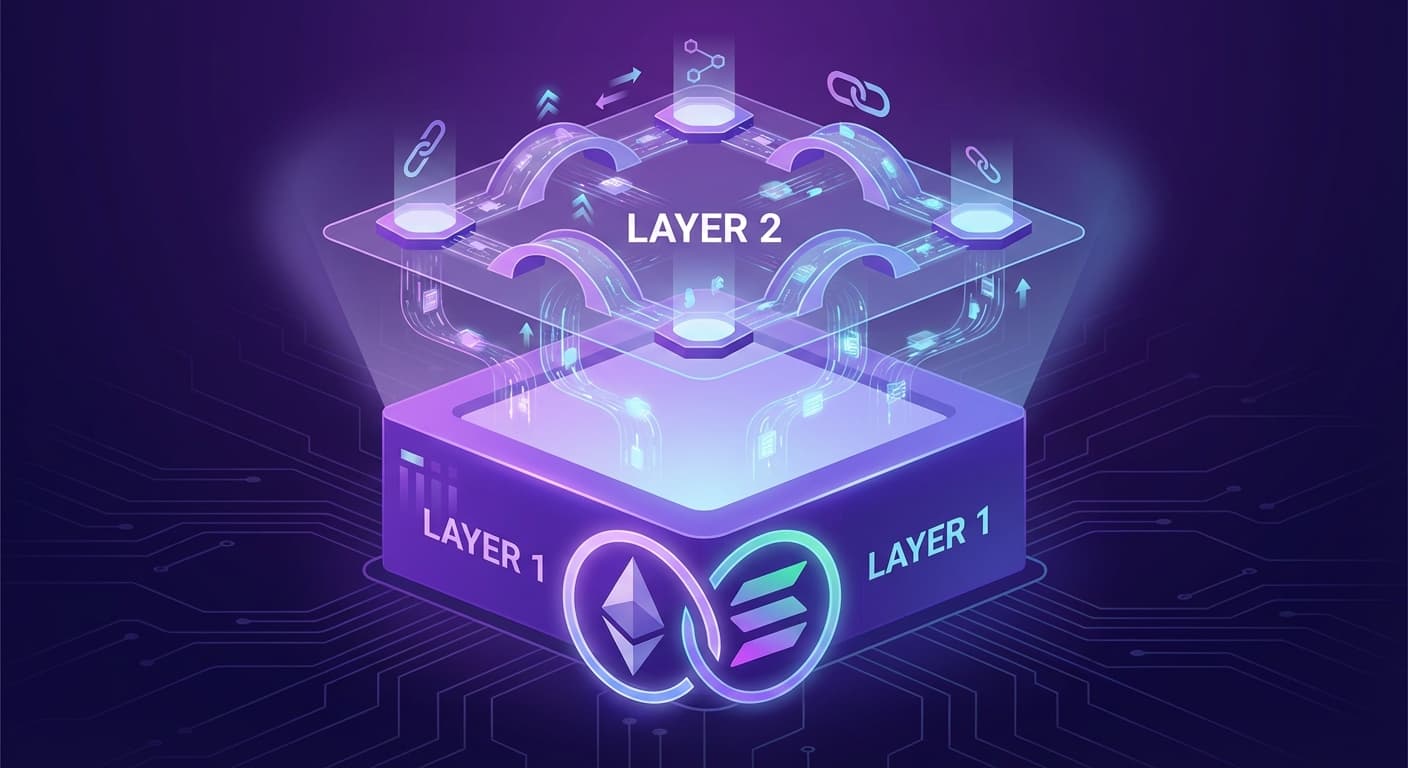
Layer 1 vs Layer 2: Key Differences, When to Use Each, and Top Projects
Not sure whether to use Layer 1 or Layer 2? Compare L1 vs L2 blockchains — rollup types, costs, speed, risks, and which chain fits your use case in 2026.
 GOMTU9 min read
What Are Smart Contracts? How They Work and Real Use Cases
Discover what smart contracts are, how they work on the blockchain, and their real-world use cases in DeFi, NFTs, and RWA — plus risks, limits, and FAQ.
GOMTU7 min read
Modular Blockchains Explained: Rollups, Data Availability, and the New Stack (2026)
What is a modular blockchain, and why did the industry pivot to it? A plain-English guide to the four layers, Celestia vs EigenDA, and the real trade-offs.
GOMTU10 min readExplore related topics
Crypto Airdrop Farming Guide 2026: Qualify Without Gambling Your Wallet
A practical crypto airdrop farming guide for 2026: evaluate campaigns, limit wallet risk, verify claims, keep records, and avoid Sybil abuse.
GOMTU8 min read
Crypto Wallet Security: Your Complete Hub for Keys, Scams & Safe Custody
Everything you need to know about crypto wallet security — seed phrases, smart wallets, bridge risks, and scam prevention. Your gateway to staying safe on-chain.
GOMTU11 min read