DePIN Explained: How Decentralized Physical Infrastructure Works (2026)
DePIN connects crypto incentives to real-world hardware — wireless, GPUs, storage, sensors. Learn how Helium, Render & Akash work, the AI link, and the risks.

Last updated
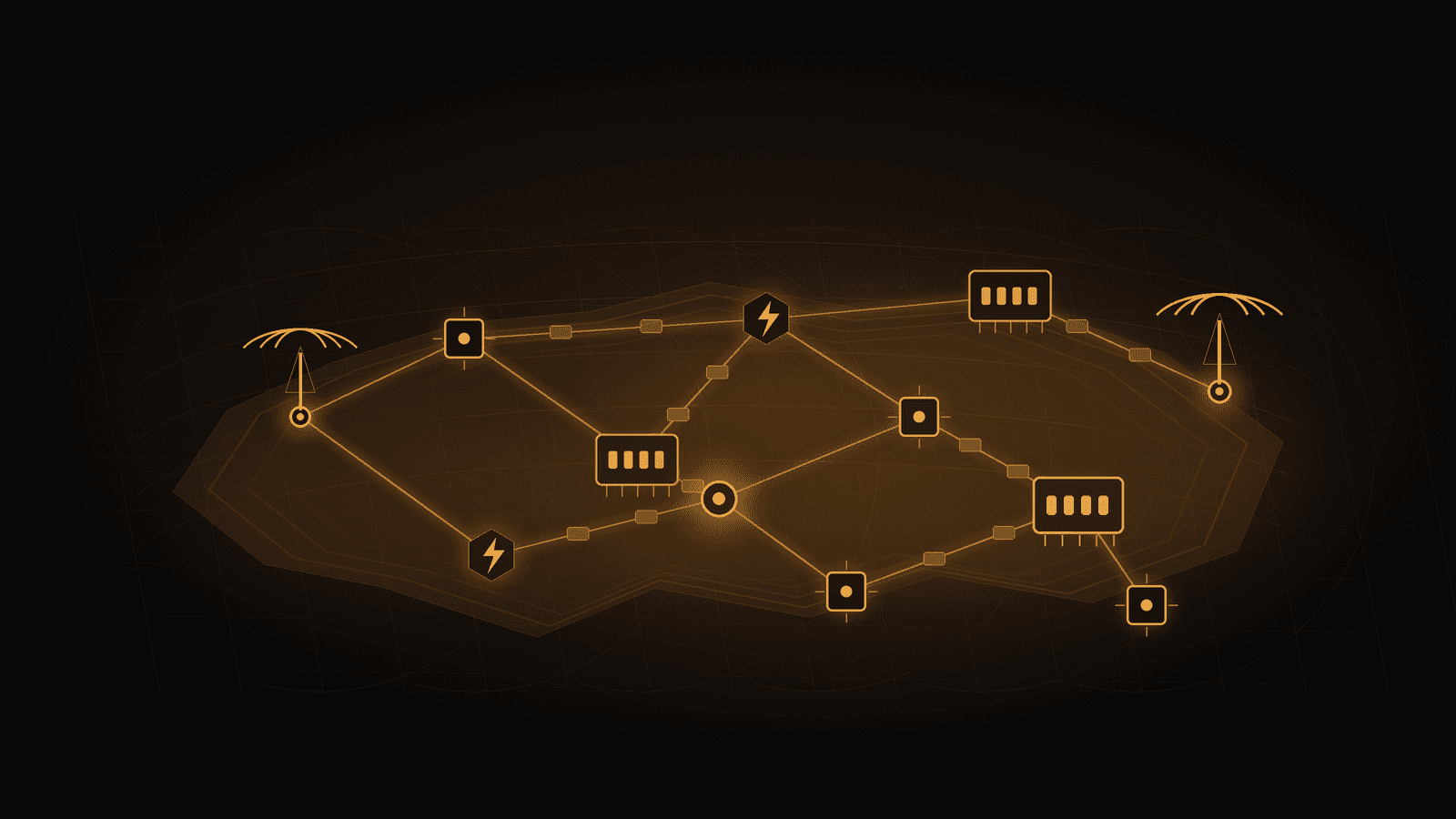
Most crypto projects ask you to trust a whitepaper. DePIN asks you to look at the hardware.
Networks like Helium, Render, and Akash don't run on promises — they run on antennas, GPUs, and hard drives owned by thousands of regular people. By early 2026 the sector held roughly $9–10 billion in market cap across 650+ projects, and in January 2026 alone leading networks recorded around $150 million in on-chain revenue — up as much as 800% year-over-year for some. The AI compute boom is pouring fuel on the fire.
Before you dive in, though, hardware economics and token sustainability carry real risks worth understanding first. This guide walks you through everything — from the core idea and how it works to the risks you should weigh before buying a token or deploying a device.
What Is DePIN?
DePIN stands for Decentralized Physical Infrastructure Networks. In plain English: a blockchain-coordinated network where regular people supply real hardware, the protocol pays them in tokens for doing useful work, and anyone can buy the resulting service.
It flips the traditional infrastructure model on its head. A telecom giant normally spends billions building a network from the top down — one company, one owner, one choke point. DePIN builds from the bottom up: thousands of individuals deploy devices, a blockchain verifies their work, and the protocol pays them. The result can scale faster and more cheaply than any single company could fund alone.
Note
The simplest way to picture DePIN: a device joins a network, performs a service, and gets paid in tokens when that service is verified. Everything else is detail.
How DePIN Works: An Everyday Analogy
Think of an Airbnb model — but for physical infrastructure instead of spare rooms.
With Airbnb, homeowners list unused space; guests book it; Airbnb coordinates and takes a cut. With DePIN, hardware owners list unused capacity (bandwidth, GPU cycles, disk space, sensor data); buyers purchase it; a blockchain protocol coordinates everything and pays the contributors. There's no DePIN Inc. setting the rules. The protocol does that, encoded in code that anyone can read.
The key ingredient is verification. Airbnb relies on reviews to confirm a room exists. DePIN uses cryptographic proofs:
- Proof of Coverage — wireless networks cryptographically confirm that a hotspot actually provides the coverage it reports.
- Proof of Storage — storage networks prove data has been genuinely held over a period of time.
- Proof of Physical Work — the general pattern: attest that real-world work occurred before issuing a reward.
Weak verification is fatal. If measurement is easy to fake, fraudsters spin up fake devices to farm rewards and the whole incentive system collapses. Strong proof mechanisms are what separate viable DePIN projects from ones that will fail.
The DePIN Flywheel
Most DePIN economies run on a burn-and-mint equilibrium:
- The network mints tokens to reward hardware suppliers (the supply side).
- Customers who want the service pay in fiat-denominated usage credits, created by burning the native token.
- More demand → more burning → better rewards → more supply → better service → more demand.
When real usage is strong, burning offsets emissions and the token can hold value. When usage is weak, the network is effectively paying subsidies out of thin air — that's the key thing to watch.
DePIN Categories and Real Projects
DePIN spans five broad verticals in 2026:
| Category | What it provides | Example networks |
|---|---|---|
| Wireless & Telecom | Cellular and IoT coverage | Helium |
| GPU Compute & Rendering | AI and graphics compute | Render, Akash, io.net |
| Storage | Decentralized file storage | Filecoin |
| Mapping & Navigation | Geospatial and dashcam data | Hivemapper |
| IoT, Sensors & Energy | Environmental data, energy grids | IoTeX, DIMO |
Real-World Applications
So who actually buys from DePIN networks? More than you might expect.
- AI companies buying discounted GPU time from Render or Akash rather than waiting for reserved cloud capacity.
- Enterprise logistics using Hivemapper's crowd-sourced map data to keep routing current without paying Google or HERE.
- Mobile users on Helium Mobile getting cellular coverage at rates below the major carriers.
- IoT builders tapping IoTeX or DIMO for real-time environmental and vehicle data without building their own sensor network.
The AI agents in crypto buildout is a major accelerant: AI systems need continuous compute, storage, and bandwidth — DePIN provides all three through open, decentralized markets that often undercut centralized cloud providers on price.
Why DePIN Matters in 2026
Several things have converged to make 2026 different from previous DePIN cycles.
Real revenue, not just tokens. Render Network generated about $38 million in monthly revenue in January 2026, running ~5,600 active GPU nodes and rendering 67M+ cumulative frames. Akash hit a record $5 million in compute spend in Q1 2026, with its AkashML platform processing 1.7 billion tokens per day for AI inference. These are paying enterprise customers, not speculators.
Scale. Helium built a peer-to-peer wireless network of 980,000+ hotspots across 180+ countries, then pivoted into a 5G mobile carrier (Helium Mobile) with real subscribers paying real bills.
AI tailwinds. The AI boom creates structural demand for decentralized compute, storage, and bandwidth. DePIN networks are positioned as cheaper, censorship-resistant alternatives to AWS, Google Cloud, and Azure for certain workloads.
Composability. DePIN networks can stack. A single AI workflow might use Akash for compute, Filecoin for storage, and a DePIN bandwidth network for data transfer — all decentralized, all on-chain.
That shift from token subsidies to genuine enterprise demand is what separates 2026's DePIN story from the 2021 narrative.
Risks and Limitations
Warning
DePIN tokens are high-risk assets. Many networks still pay out more in emissions than they earn in revenue, and hardware economics can turn unprofitable quickly.
- Hardware deployment risk: Devices fail, operators churn, and maintenance is messy. Your ROI on a miner or node can collapse if token prices or reward rates drop — and in crypto, both can drop fast.
- Verification and Sybil risk: Weak proof systems invite fraud. Attackers spin up fake or co-located devices to farm rewards without providing genuine service.
- Provider concentration: Studies show meaningful inequality (high Gini coefficients) in networks like Filecoin and Helium — a few large operators control a disproportionate share, undercutting the decentralization thesis.
- Regulatory exposure: Helium's 5G operates in licensed spectrum bands, creating potential spectrum-licensing and compliance costs in multiple jurisdictions. DePIN projects touching regulated industries (telecom, energy, finance) face evolving compliance risk.
- Token-subsidy sustainability: A network generating little real revenue is effectively printing rewards. Always check revenue and utilization, not just token price.
- Market volatility: Even networks with strong fundamentals have tokens subject to broad crypto market swings. Hardware costs are paid in fiat; rewards are paid in tokens. That mismatch is a real economic risk to model before deploying hardware.
Do your own research and treat any DePIN token or hardware investment as high-risk capital.
FAQ
Q: Do I need to buy a token to use a DePIN network? Using the service and investing in the token are different decisions. You typically pay in usage credits or the native token to consume a service — but you're not required to hold tokens speculatively. Choosing to run hardware is a separate, higher-risk decision that deserves its own evaluation.
Q: Is DePIN the same as the sharing economy (Airbnb, Uber)? It shares the same intuition — idle capacity monetized by many participants — but DePIN uses blockchain to remove the central platform. There's no DePIN Inc. setting the rules and taking a cut. The protocol does that, and the rules are encoded in auditable code.
Q: What's the difference between DePIN and DeFi? DeFi deals with financial services (lending, trading, yield) on-chain. DePIN deals with physical infrastructure (compute, wireless, storage) coordinated on-chain. They often overlap — DePIN tokens are frequently traded in DeFi markets.
Q: Can I earn passive income from DePIN without running hardware? You can hold or stake tokens, but that's token speculation — you're not contributing to the network. Actual DePIN income comes from operating hardware: running a hotspot, offering GPU time, or contributing storage. Staking yields, if available, come with their own token-price risk.
Q: How do I evaluate whether a DePIN project is legitimate? Check three things: (1) Does it have real, paying customers — not just token holders? (2) Is the verification mechanism robust enough to resist Sybil attacks? (3) Is the burn-and-mint ratio sustainable at current utilization? A compelling narrative is not a substitute for any of these.
Where to Go From Here
DePIN is one of the rare crypto sectors where the product is tangible: hotspots, GPUs, and drives doing real work for real customers, with on-chain revenue to show for it. The AI compute boom gives it genuine, growing demand. But verification, hardware economics, provider concentration, and token sustainability are real risks worth taking seriously.
Evaluate networks on revenue and utilization, not narrative. Read the tokenomics. Understand the proof mechanism. And if you're considering deploying hardware, model your break-even at multiple token-price scenarios — not just the optimistic one.
DePIN is infrastructure first and a token second. Approach it that way.
Important
This article is educational and not financial advice. DePIN tokens and hardware investments carry significant risk. Do your own research before buying tokens or deploying devices. (NFA / DYOR)
Keep learning

Crypto AI Agents Explained: Wallets, ERC-8004, and Real Risks
Learn how crypto AI agents use wallets and smart contracts, how ERC-8004 adds identity and trust signals, and which risks still require human controls.
 GOMTU6 min read
Ethereum eth_getProof Guide: Verify Account and Storage State
Learn what eth_getProof returns, how account and storage proofs connect to a block state root, and which trust and availability limits still matter.
GOMTU8 min read
Ethereum Merkle Patricia Trie: How the State Root Proves the Network
Ethereum uses Merkle Patricia tries to commit accounts, contract storage, transactions, and receipts to compact roots. Learn how the structure works.
GOMTU7 min readExplore related topics

Polkadot Halving 2026: DOT Supply Cap, 53.6% Emission Cut Explained
Polkadot undergoes its first-ever tokenomics overhaul on March 14, 2026 — a 2.1B DOT supply cap, 53.6% emission cut, and staking redesign. Here is what the changes actually mean.
GOMTU8 min read
Crypto Airdrop Farming Guide 2026: Qualify Without Gambling Your Wallet
A practical crypto airdrop farming guide for 2026: evaluate campaigns, limit wallet risk, verify claims, keep records, and avoid Sybil abuse.
GOMTU8 min read