Bitcoin Hits 20 Million Coins Mined: What the Scarcity Milestone Tells Us
On March 9, 2026, Bitcoin mined its 20 millionth coin — 95.2% of all supply is now in circulation. A look at the supply architecture, halving schedule, and observable patterns from past cycles. Not financial advice.

Last updated
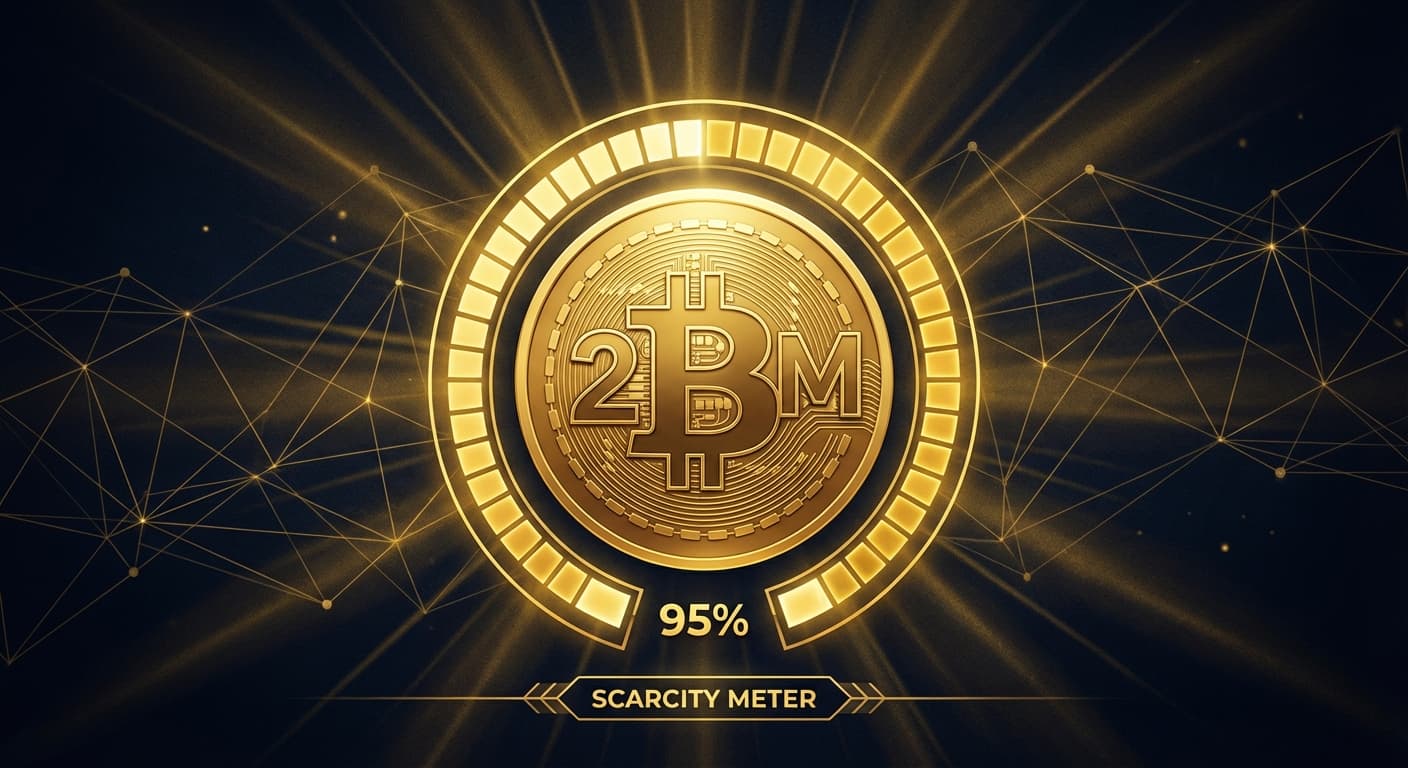
Crypto volatility feels random — until you look at the supply schedule underneath it. On March 9, 2026, Bitcoin crossed a threshold baked into its code from day one: its 20 millionth coin was mined. That leaves just 1 million remaining, to be released over the next 114 years. This article is not about where price goes next. It is about how Bitcoin's supply actually works — and what patterns have been observed after similar milestones in the past.
What This Milestone Actually Means
When someone says "Bitcoin hit 20 million mined," they are describing a point on a countdown timer that has been running since 2009.
Bitcoin's protocol hardcodes a 21 million coin cap. No government, central bank, or developer team can change it. The 20-million mark means 95.2% of all Bitcoin that will ever exist is already out in the world. The remaining 4.8% will trickle out at an ever-slowing pace through 2140.
For context on why this lands in the crypto market news category: this is less about a single day's event and more about a structural feature of Bitcoin becoming impossible to ignore.
Bitcoin's Supply Architecture
Think of Bitcoin's supply like an hourglass where the opening keeps getting narrower. Miners turn computational work into new coins — but the rate at which new coins appear is programmed to shrink on a fixed schedule.
Bitcoin uses Proof of Work (PoW): miners compete to solve cryptographic puzzles, and whoever wins gets to add the next block to the chain and collect the block reward. The current reward is 3.125 BTC per block, or roughly 450 BTC per day across the whole network.
That number keeps halving on schedule. Every ~210,000 blocks (about four years), the block reward is cut in half — permanently. This mechanism is called the halving, and it is the engine that makes Bitcoin's supply schedule more predictable than any central bank policy.
Halving History and Schedule
| Halving | Year | Block Reward | Daily Output | Annual Inflation |
|---|---|---|---|---|
| Genesis | 2009 | 50 BTC | ~7,200 | — |
| 1st | 2012 | 25 BTC | ~3,600 | ~8.3% |
| 2nd | 2016 | 12.5 BTC | ~1,800 | ~4.2% |
| 3rd | 2020 | 6.25 BTC | ~900 | ~1.8% |
| 4th | 2024 | 3.125 BTC | ~450 | ~0.85% |
| 5th (est.) | 2028 | 1.5625 BTC | ~225 | ~0.4% |
| 6th (est.) | 2032 | 0.78125 BTC | ~112 | ~0.2% |
After the April 2024 halving, Bitcoin's annual issuance rate dropped below 0.85% — lower than gold's estimated annual supply growth of roughly 1.5–2%. That comparison appears frequently in the "digital gold" narrative, though it is worth noting that gold and Bitcoin serve different markets with different risk profiles.
Timeline for the Last 1 Million BTC
| Period | BTC to Be Mined | Cumulative Total |
|---|---|---|
| 2026–2028 | ~328,500 | ~20.32M |
| 2028–2032 | ~328,125 | ~20.65M |
| 2032–2036 | ~164,062 | ~20.81M |
| 2036–2040 | ~82,031 | ~20.89M |
| … | … | … |
| ~2140 | Last satoshi | 21M |
The first 20 million took 17 years. The last million will take over 114. That asymmetry is what compounding halvings look like on a timeline.
Note
Each halving does not just slow new supply — it permanently lowers the rate at which Bitcoin can ever be issued. The schedule is asymptotic, not linear.
How Much Bitcoin Is Actually in Circulation?
The "20 million mined" headline overstates what is genuinely tradeable. A significant portion of those coins appear to be permanently gone.
Estimated Lost Bitcoin
Analysts estimate 2.3–3.7 million BTC are inaccessible:
- Satoshi Nakamoto's wallets: ~1.1M BTC, unmoved since the early years
- Lost private keys and seed phrases: Early miners who never made secure backups
- Hardware failures: Drives discarded, destroyed, or simply forgotten
- Intentional burns: Coins sent to provably unspendable addresses
Effective Supply Snapshot
| Category | Estimated Amount |
|---|---|
| Total mined | ~20M BTC |
| Estimated permanently lost | ~2.3–3.7M BTC |
| Effective tradeable supply | ~15.8–17.7M BTC |
| Still to be mined | ~1M BTC |
The real liquid supply could be as low as ~15.8 million coins — meaningfully scarcer than the 21-million headline implies.
Warning
Lost coins are irretrievably gone. Unlike a forgotten bank account, no institution can recover Bitcoin sent to an inaccessible address or locked behind a missing private key.
Institutional Demand and On-Chain Context
As of March 2026, Bitcoin ETFs hold approximately $88 billion worth of BTC — around 6% of total supply. For deeper background on how these products work, the Bitcoin ETF guide covers the mechanics.
Major Holders (Estimated, March 2026)
| Holder | Estimated BTC |
|---|---|
| Bitcoin ETFs | ~1.3M BTC |
| MicroStrategy | ~470K BTC |
| Government holdings | ~500K+ BTC |
| Exchange balances | Declining trend |
Exchange-held BTC balances have trended down since 2022 while institutional holdings have grown. This on-chain dynamic — coins moving off exchanges and into long-term custody — is observable data. What it means for future prices depends on variables no one can fully predict in advance.
Patterns from Past Halvings — Observation, Not Prediction
This section comes with an important label: what follows describes what has happened historically around halving events. It is not a claim about what will happen.
After the 2012 halving (1st): Daily new issuance dropped sharply and miner revenue per coin rose. Price action was highly volatile in both directions over the following year.
After the 2016 halving (2nd): A cycle of accumulation, expansion, distribution, and correction played out over roughly 12–18 months. A broadly similar pattern recurred after the 2020 halving — though timing and magnitude differed.
After the 2020 halving (3rd): Institutional entry via futures, Grayscale trusts, and later ETF demand coincided with the cycle. On-chain data showed long-term holder accumulation growing before price expansion phases, and again before the subsequent drawdown.
Common observations across cycles:
- Miner selling pressure has tended to decrease post-halving as less profitable miners exit
- "Coin age" metrics — how long coins have been unmoved — have historically risen ahead of major price moves in both directions
- Volatility, not directional certainty, is the feature that repeats most consistently
These patterns are starting points for analysis, not guarantees of repetition. Bitcoin's market structure has changed substantially with each cycle — most notably with spot ETF approval in early 2024, which introduced new demand channels that did not exist in earlier halvings.
Risks and What to Watch
Scarcity is one variable in a complex system. Holding or considering Bitcoin involves real risks that deserve direct acknowledgment:
- Price volatility: Bitcoin has historically seen drawdowns of 70–80% from cycle peaks. Scarcity does not prevent large price drops, and past cycles do not cap future declines
- Regulatory uncertainty: Government responses to Bitcoin — from outright restrictions to strategic reserve designations — vary widely and can shift quickly
- Miner economics: As block rewards halve further, network security depends increasingly on transaction fee revenue. This transition is gradual but unproven at scale
- Custody risk: Holding Bitcoin directly requires careful wallet security and seed phrase management. Errors are irreversible
- Competing networks: Other layer-1 blockchains compete for developer activity and institutional attention. Network effects matter, but dominance is not structurally guaranteed
For foundational context on how the underlying technology works, What is Blockchain? is a useful starting point. The gas fees explainer covers transaction economics, and DEX vs CEX compares trading venue options.
Frequently Asked Questions
Why can't someone just change Bitcoin's 21-million cap? The cap is enforced by the network's consensus rules. Changing it would require the majority of nodes and miners worldwide to adopt the rule change — and historically, proposals that alter Bitcoin's core monetary policy have faced strong rejection from the community. It is not impossible in theory, but there is no precedent for it.
What happens when the last Bitcoin is mined around 2140? Miners will no longer receive block subsidies and will rely entirely on transaction fees for revenue. Whether fees will be sufficient to maintain network security at that point is an open economic question that will play out over many decades. The transition is gradual — each halving nudges the ratio slightly further toward fees.
Does scarcity mean the price will go up? Not automatically. Scarcity is one supply-side factor. Price is determined by the interaction of supply and demand — and demand can contract as well as grow. Volatility in both directions is the consistent feature of Bitcoin markets, not a guaranteed direction.
How do I know if my Bitcoin is actually secure? Proper custody means using a hardware wallet, storing your seed phrase offline, and avoiding single points of failure. See the wallet security guide for practical steps.
Is this a good time to buy Bitcoin? This article does not make that call — and neither should any article you read online. Investment decisions depend on your individual financial situation, risk tolerance, and time horizon. Do your own research, consider talking to a qualified financial professional, and only allocate what you can genuinely afford to lose.
Closing Thoughts
The 20-million milestone is a verifiable moment in Bitcoin's supply schedule — one that was mathematically inevitable from the day Satoshi Nakamoto wrote the genesis block. What it tells us is structural: Bitcoin's issuance rate now sits below gold's estimated annual growth, the remaining supply will emerge at an extremely slow pace, and a meaningful portion of already-mined coins are permanently inaccessible.
What it cannot tell you is where price goes next. That question involves demand, regulation, macro conditions, and market sentiment — none of which the supply schedule answers.
If you are exploring Bitcoin seriously, start with the fundamentals. Understand how the blockchain works, how to custody assets safely, and what your actual risk tolerance is. The supply math is fascinating. The market is volatile. Do your own research.
Note
This article is for informational purposes only and does not constitute investment advice. Bitcoin investment carries significant risk of loss. All investment decisions should be made based on your own research and judgment. Not financial advice (NFA) — DYOR.
Keep learning

Ethereum Glamsterdam Upgrade: ePBS, BALs, and What Is Actually Planned
Ethereum Glamsterdam is expected in Q4 2026. Learn its frozen scope, Sepolia milestone, ePBS, block-level access lists, and remaining uncertainties.
 GOMTU7 min read
Polkadot Halving 2026: DOT Supply Cap, 53.6% Emission Cut Explained
Polkadot undergoes its first-ever tokenomics overhaul on March 14, 2026 — a 2.1B DOT supply cap, 53.6% emission cut, and staking redesign. Here is what the changes actually mean.
GOMTU8 min read
GENIUS Act Stablecoin Rules: What the 2026 Proposals Actually Change
The GENIUS Act is law, but implementation is still underway. Understand the 2026 OCC and customer-ID proposals, effective dates, protections, and risks.
GOMTU8 min readExplore related topics
Merkle Trees and Merkle Proofs Explained: Verify Data Without the Whole Blockchain
Learn how Merkle trees compress many transactions into one root hash, how inclusion proofs work, and where Bitcoin, Ethereum, and rollups use them.
GOMTU7 min read
Ethereum Block-Level Access Lists: How EIP-7928 Maps State
Learn how EIP-7928 block-level access lists record Ethereum state access, enable parallel validation and executionless sync, and differ from EIP-2930.
GOMTU8 min read