Bitcoin ETF Explained: What It Is, How It Works, and What to Know Before Investing
Spot vs futures Bitcoin ETFs explained, top funds compared (IBIT, FBTC, BITB), how they work, and the real risks — a plain-English guide for 2026.

Last updated
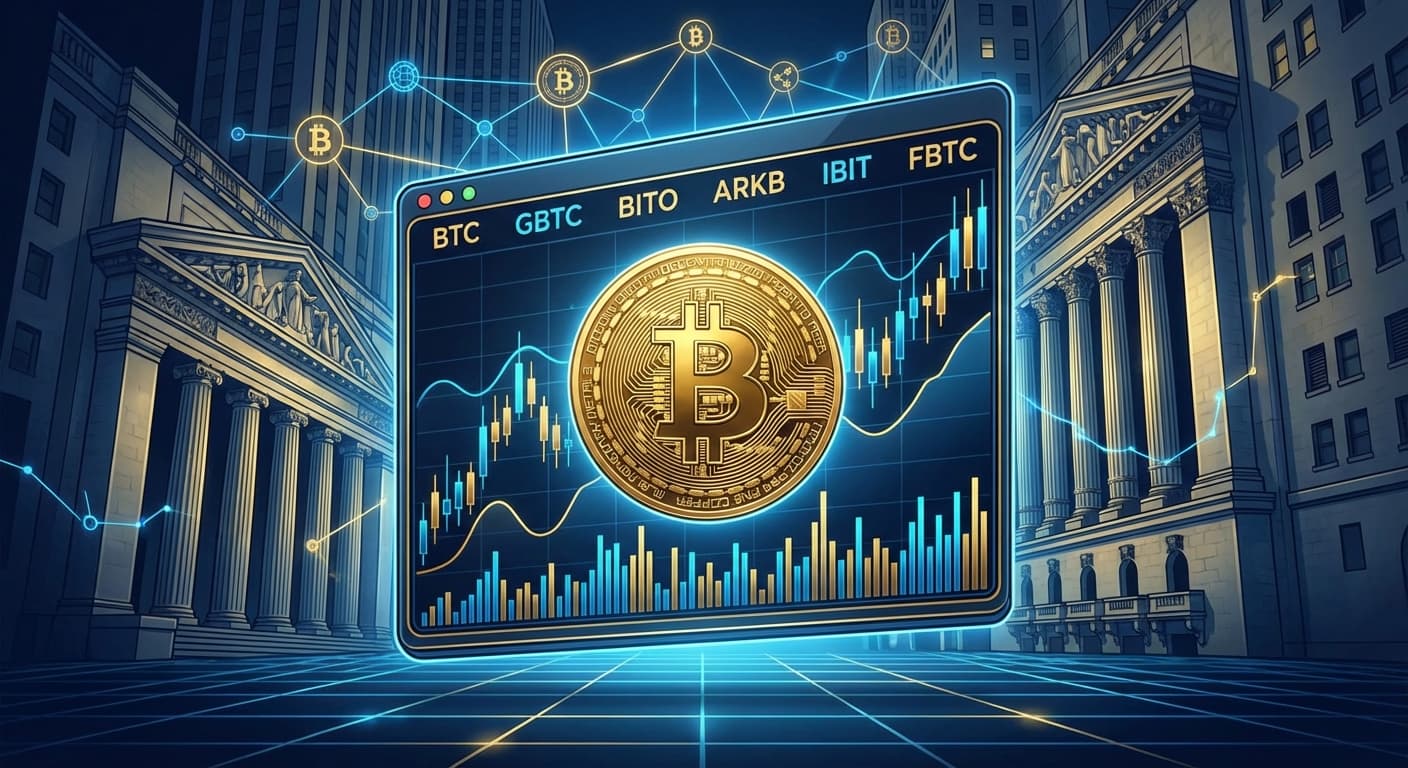
You've probably noticed Bitcoin showing up in places it never used to — inside 401(k) menus, on Fidelity's homepage, and in the annual reports of Morgan Stanley and Citi. That shift didn't happen by accident. In January 2024, U.S. regulators approved the first spot Bitcoin ETFs, unlocking access for anyone with a standard brokerage account. That's the opportunity. But before you click "buy," it's worth understanding exactly what you're getting — and what you're not.
What Is a Bitcoin ETF?
A Bitcoin ETF (Exchange-Traded Fund) is a regulated investment fund that tracks Bitcoin's price and trades on traditional stock exchanges like the NYSE. You buy and sell shares the same way you'd trade Apple stock or a gold ETF — no crypto wallet, no private keys, no seed phrase required.
Think of it like a gold ETF. When you buy GLD, you don't receive a gold bar in the mail. You own exposure to gold's price through a regulated financial product. A Bitcoin ETF works exactly the same way: the fund manager holds actual Bitcoin on your behalf, and your shares track the price. You get the price exposure without the custody responsibility.
On January 11, 2024, the SEC approved 11 spot Bitcoin ETFs simultaneously — a landmark moment that opened a regulated gateway between traditional finance and crypto. Bitcoin ETFs now sit at the center of the broader real-world asset investment landscape, alongside tokenized commodities and other regulated crypto products.
Direct Bitcoin vs Bitcoin ETF — What You Actually Own
| Feature | Direct Bitcoin | Bitcoin ETF |
|---|---|---|
| Account | Crypto exchange | Brokerage account |
| Custody | You manage your wallet | Fund manager holds it |
| Seed phrase | Must manage yourself | Not needed |
| Trading hours | 24/7 | US market hours only |
| Tax treatment | Crypto tax rules | Stock/ETF tax rules |
| Annual fees | 0% (exchange fees apply) | 0.15–0.25% |
| IRA/401k eligible | No | Yes |
How Does a Bitcoin ETF Work? Spot vs Futures
Not all Bitcoin ETFs are the same. The most important distinction is between spot ETFs and futures ETFs.
Spot ETFs hold actual Bitcoin. When you buy shares of IBIT or FBTC, the fund purchases real BTC and holds it in institutional custody. Your share price tracks Bitcoin's actual market price closely.
Futures ETFs hold Bitcoin futures contracts — agreements to buy Bitcoin at a set price in the future. Here's the catch: these contracts expire and must be "rolled over" into new ones regularly. This rolling process generates costs, especially in a market condition called contango, where futures prices run higher than spot prices. Over months and years, these costs compound and erode performance compared to spot ETFs.
Think of it this way: owning a spot ETF is like locking a barrel of oil in a vault. A futures ETF is like holding a stack of monthly IOU notes for oil — you pay to renew each note, and the bill adds up.
| Feature | Spot ETF | Futures ETF |
|---|---|---|
| Holds | Actual Bitcoin | Bitcoin futures contracts |
| Price tracking | Accurate | Drift from rollover costs |
| Annual fees | 0.15–0.25% | 0.65–0.95% |
| Tracking error | Low | Higher (contango) |
| Approved | January 2024 | October 2021 (BITO) |
| Examples | IBIT, FBTC | BITO, BITX |
For most long-term investors, spot ETFs are the more efficient structure.
Top Spot Bitcoin ETFs Compared
| ETF | Ticker | Manager | AUM | Fee | Key Feature |
|---|---|---|---|---|---|
| iShares Bitcoin Trust | IBIT | BlackRock | $70.6B | 0.25% | Largest, most liquid |
| Wise Origin Bitcoin Fund | FBTC | Fidelity | $18.7B | 0.25% | Best IRA/retirement access |
| Bitwise Bitcoin ETF | BITB | Bitwise | ~$3.5B | 0.20% | Low fee, crypto-native research |
| ARK 21Shares Bitcoin ETF | ARKB | ARK/21Shares | ~$3.2B | 0.21% | ARK brand, active crypto thesis |
| Franklin Bitcoin ETF | EZBC | Franklin Templeton | ~$500M | 0.19% | Lowest expense ratio |
BlackRock's IBIT dominates with $70.6B in AUM — representing roughly 96% of total net inflows across all Bitcoin ETFs. For most investors, it's the default choice for liquidity and institutional-grade custody. FBTC is the pick for seamless IRA integration via Fidelity. EZBC and BITB are worth considering if minimizing the expense ratio matters most.
How to Access Bitcoin ETFs
- Open a brokerage account — Fidelity, Charles Schwab, Interactive Brokers, and Robinhood all support Bitcoin ETF trading. For tax-advantaged exposure, consider a Roth IRA.
- Fund your account — via bank transfer or ACH.
- Search by ticker — type "IBIT" or "FBTC" and place a buy order. Most platforms support fractional shares, making it accessible at any investment size.
- Choose your strategy — long-term hold, recurring DCA purchases (e.g., a fixed amount weekly), or IRA contribution.
Why Bitcoin ETFs Matter
Before January 2024, institutional investors — pension funds, endowments, registered investment advisors — largely couldn't hold Bitcoin in regulated portfolios. ETFs changed that. Today, Bitcoin ETFs collectively hold approximately 6% of all Bitcoin in circulation, with around $88 billion in total AUM. Major banks including Morgan Stanley and Citi now offer Bitcoin ETF access to clients.
The ripple effects extend beyond Bitcoin. Ethereum ETFs were approved in July 2024, and following the 2025 Staking Amendment, ETH ETF holders can now receive staking yield directly. Bitcoin ETFs sit within a broader movement toward regulated on-exchange access to crypto assets — alongside products like tokenized gold, tokenized stocks, and real-world asset tokenization.
Risks and Limitations
Volatility — The Core Risk
Warning
ETF packaging does not reduce Bitcoin's price volatility. Bitcoin dropped approximately 47% from its 2025 peak to the $66–69K range in early 2026. That drawdown applies equally to ETF holders as to direct Bitcoin owners. Only invest what you can afford to lose entirely.
Fee Drag Over Time
A 0.25% annual fee compounds silently. Over ten years, it adds up to roughly 2.5% of your investment going to management fees. Direct Bitcoin ownership has no ongoing management fee — though it shifts the burden to self-custody security management.
Market Hours Limitation
Bitcoin trades 24/7. ETFs only trade during U.S. market hours (9:30 AM – 4:00 PM ET, weekdays). Significant overnight or weekend price moves cannot be acted upon until markets reopen — a meaningful constraint given crypto's around-the-clock volatility.
Premium/Discount and Tracking Error
ETF share prices can temporarily diverge from actual Bitcoin prices. Large, liquid ETFs like IBIT maintain tight tracking due to their size. Smaller or less-traded ETFs may show wider gaps during volatile periods.
Regulatory Uncertainty
The regulatory environment for crypto assets remains in flux. Future rule changes could affect fund structures, fees, or availability. The SEC's evolving stance on crypto is worth monitoring as a long-term investor.
FAQ
Bitcoin ETF or buying Bitcoin directly — which is better? It depends on your goals. For simplicity, tax optimization, and retirement account access, ETFs are a better fit. For DeFi participation, on-chain transactions, or airdrop farming, direct ownership is necessary. Many investors hold both for different purposes. Neither is universally "better."
Are Bitcoin ETF fees too high? At 0.19–0.25% annually, they're moderate by ETF standards — lower than popular gold ETFs like GLD (0.40%). For very long-term holders comfortable with self-custody, direct ownership at 0% ongoing cost may be more economical. Know your trade-offs before deciding.
Can I withdraw Bitcoin from an ETF? No. ETFs are financial products that provide price exposure, not the underlying coins. You cannot transfer holdings to a Bitcoin wallet or use them on-chain. For on-chain utility, direct ownership is required.
Are there Bitcoin ETFs outside the U.S.? Yes — Canada and several European countries have offered Bitcoin ETFs or ETPs since 2021. The U.S. approval in 2024 was significant for its scale and for legitimizing Bitcoin in the world's largest capital markets.
Are Bitcoin ETFs good for the broader market? They've been a meaningful catalyst for institutional adoption. With ETFs holding ~6% of supply in regulated vehicles, market liquidity has deepened. ETF inflow and outflow data has also emerged as a closely-watched leading indicator for short-term price direction — something worth tracking if you follow market dynamics.
Conclusion
Bitcoin ETFs have meaningfully lowered the barrier to Bitcoin price exposure — no wallets, no seed phrases, and full compatibility with existing brokerage accounts and retirement plans. The trade-offs are real: you pay an annual management fee, you're exposed to full Bitcoin volatility, and you can't interact with the Bitcoin network directly.
Whether ETF exposure belongs in your portfolio is a decision that depends on your goals, time horizon, and risk tolerance. Explore the broader real-world asset space for context, weigh the options carefully, and make decisions based on your own research — not headlines.
Disclaimer: This article is for informational purposes only and does not constitute financial or investment advice. Bitcoin and Bitcoin ETF investments carry significant risks including price volatility, management fees, and regulatory uncertainty. Past performance is not indicative of future results. Always do your own research (DYOR). NFA.
Keep learning

Tokenized Stocks Guide 2026: How xStocks, Robinhood & Onchain Equities Work
Tokenized stocks let you hold Apple, Nvidia, and Tesla as blockchain tokens trading 24/7. Learn how xStocks, Robinhood, and Backed work, the four real risks, and where regulation stands in 2026.
 GOMTU7 min read
Tokenized Gold Explained: What It Is, How It Works, and What to Watch Out For
Tokenized gold lets you hold real gold in a crypto wallet, earn yield on it, and use it in DeFi — 24/7. This guide covers how it works, PAXG vs XAUT, yield-bearing options like thGOLD and GLDY, and the real risks to know before investing.
GOMTU9 min read
Bitcoin Treasury Companies Explained: The 2026 DAT Shakeout
Public companies loaded up on Bitcoin as a treasury — now the premium era is unwinding. What digital asset treasuries are, and why the mNAV flywheel stalled.
GOMTU6 min readExplore related topics
Crypto Wallet Security: Your Complete Hub for Keys, Scams & Safe Custody
Everything you need to know about crypto wallet security — seed phrases, smart wallets, bridge risks, and scam prevention. Your gateway to staying safe on-chain.
GOMTU11 min read
Bitcoin Hits 20 Million Coins Mined: What the Scarcity Milestone Tells Us
On March 9, 2026, Bitcoin mined its 20 millionth coin — 95.2% of all supply is now in circulation. A look at the supply architecture, halving schedule, and observable patterns from past cycles. Not financial advice.
GOMTU8 min read