Clear Signing vs Blind Signing: How to Read Crypto Wallet Prompts
Clear signing makes wallet prompts readable. Learn how blind signing differs, what EIP-712 and draft ERC-7730 do, and what to verify.

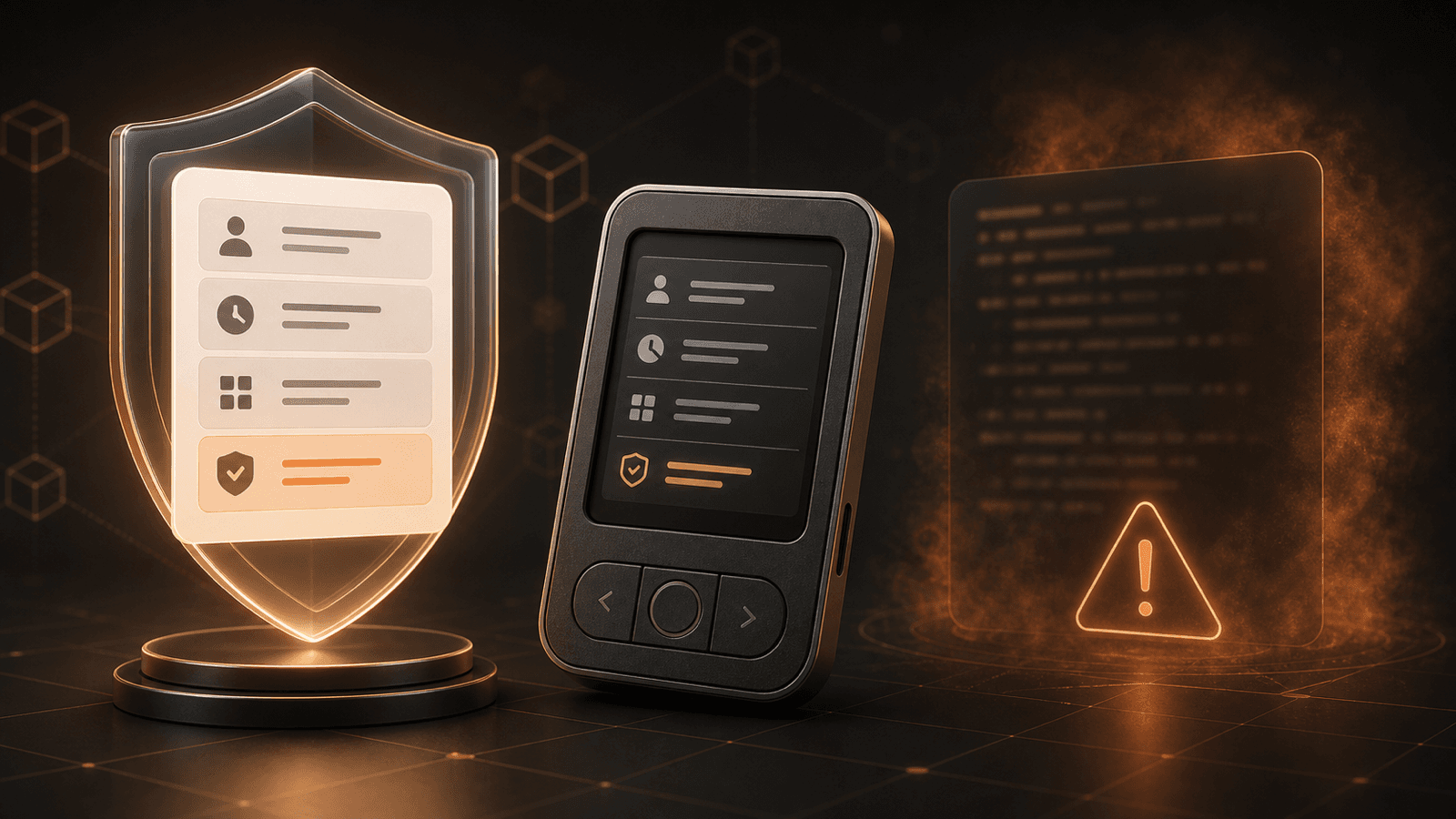
A wallet confirmation can be the final checkpoint between you and a malicious request. Yet many prompts still resemble a sealed contract written in machine code: you can press Confirm, but you cannot confidently explain the outcome. This guide adds a practical layer to crypto wallet security: how to distinguish clear signing from blind signing, what the supporting standards do, and when the safest action is to reject the request.
Not financial advice (NFA). Clearer prompts can reduce mistakes, but they cannot prove that an app is safe or eliminate smart-contract, phishing, device, and market risks. Verify independently, use only funds you can afford to lose, and do your own research (DYOR).
What Clear Signing and Blind Signing Mean
Think of signing like authorizing a bank transfer.
- With clear signing, the confirmation shows the action in human terms: what you are doing, which asset and amount are involved, who receives authority or funds, and which network or contract is in scope.
- With blind signing, the device or wallet cannot meaningfully describe the request. You may see raw hexadecimal data, a generic “message,” a hash, or an incomplete summary.
The signature is cryptographic in both cases. The difference is whether the interface gives you enough reliable context to verify your intent before the key signs.
The Ethereum Foundation describes “What You See Is What You Sign” as the goal. Clear signing is therefore not merely prettier formatting. It is meant to make the confirmation screen a useful security boundary.
How Bytes Become a Readable Prompt
A blockchain transaction arrives as structured fields and encoded contract input, not as a sentence. A wallet needs a trustworthy way to decode the request and label the important values.
Think of a nutrition label. Raw laboratory measurements are not useful to most shoppers. A consistent label maps them into names, units, and portions you can compare. Clear signing similarly maps transaction data into an action, asset, amount, counterparty, and scope.
A useful display may identify:
- the intended action, such as transfer, swap, approval, or delegation;
- the asset and correctly formatted amount;
- the recipient, spender, or verifying contract;
- the chain on which the authorization applies;
- deadlines, nonces, limits, or other conditions.
If a critical field remains unknown, the prompt is not fully clear just because it contains a few readable labels.
EIP-712 and Draft ERC-7730 Play Different Roles
These standards are related, but they are not interchangeable.
EIP-712 structures off-chain messages
EIP-712 defines a standard way to hash and sign typed structured data. Instead of only an opaque byte string, a wallet can receive named types, a domain, and message fields.
The domain may include the application name, version, chain ID, and verifying contract. This domain separation helps distinguish similar messages used by different apps or contracts. However, EIP-712 explicitly does not provide replay protection by itself. The application must design appropriate nonces, expiries, or other safeguards.
Typed does not automatically mean safe. A malicious request can use valid EIP-712 formatting, and confusing field names can still hide intent.
ERC-7730 adds display context
ERC-7730 is a draft standard for JSON descriptors that help wallets format contract calls and typed messages for human review. A descriptor can explain intent, map primitive values to meaningful labels, format token amounts, and bind the description to particular contracts or EIP-712 domains.
The draft requires wallets to check that the descriptor’s binding context matches the signed data. That is essential: applying a legitimate-looking description to the wrong contract would create false confidence.
The Ethereum Foundation’s clear-signing announcement describes a broader system: a registry, independent review and attestations, developer tooling, and wallet-controlled trust decisions. Adoption is a developing ecosystem effort, not a guarantee that every wallet or contract already supports the same display.
Clear Signing Does Not Make a Request Trustworthy
A readable prompt answers “what am I authorizing?” It does not fully answer “should I trust this?”
- Compromised front end: A hacked site can construct a harmful but readable request.
- Malicious contract: Accurate labels do not make the underlying code safe.
- Bad metadata: Registries and descriptors need review, correct binding, and trustworthy distribution.
- Partial decoding: A wallet may decode one action while omitting a nested call or consequential condition.
- Signature reuse: A message without effective nonce, expiry, or domain controls may be replayed where the app permits it.
- Screen mismatch: Your computer can show more than a hardware device. The trusted device screen is the final reference.
Clear signing strengthens one checkpoint. It does not replace URL verification, contract research, transaction simulation, allowance limits, or wallet isolation.
A Five-Point Check Before You Sign
1. Confirm the action
Does the prompt say transfer, approve, swap, permit, delegate, or sign in? A free claim should not quietly request an unlimited token approval.
2. Confirm the counterparty
Check the recipient, spender, and verifying contract. Do not trust a shortened address based only on its first and last characters; address-poisoning attacks exploit that habit.
3. Confirm value and scope
Read the asset, amount, allowance, chain, deadline, and nonce where shown. “Unlimited” is materially different from the exact amount needed for one action.
4. Compare screens
For a hardware wallet, verify details on the device itself. Treat the computer or phone as potentially compromised. If the trusted screen cannot display essential fields, you are signing with missing information.
5. Stop on ambiguity
Reject the request if you cannot explain its effect in one sentence. Return through a verified bookmark, check official documentation, and test with a separate low-value wallet when appropriate. Never enable blind signing merely because a site tells you to.
Ethereum.org’s security guidance reinforces the basics: read the transaction message, verify recipients, avoid unlimited spend limits, and remember that Ethereum transactions are irreversible.
When Blind Signing May Appear
Blind signing may appear when a wallet lacks the contract ABI, a supported descriptor, or firmware support for a request. Complex DeFi interactions, new contracts, batched calls, and uncommon typed messages can exceed what a device can decode. That explains the prompt; it does not justify approval.
If an advanced workflow genuinely requires blind signing, reduce the blast radius:
- verify the protocol domain and contract through independent official sources;
- use current wallet software and device firmware;
- simulate the transaction with a reputable tool when possible;
- use a dedicated wallet containing only what the action needs;
- set narrow token allowances and revoke stale permissions afterward;
- disable any broad blind-signing setting when the interaction is complete.
Ledger’s current Ethereum settings guidance says clear, human-readable details are sufficient for most users and describes blind signing as support for interactions the app cannot fully interpret. Wallet models differ, so follow official wallet documentation rather than a dApp pop-up.
Quick Decision Table
| What the wallet shows | What it means | Practical response |
|---|---|---|
| Action, asset, amount, counterparty, network | Stronger clear-signing context | Verify every field, then decide |
| Named EIP-712 fields but unclear scope | Structured, not necessarily understandable | Inspect domain, contract, nonce, deadline, permissions |
| Raw hex, hash, or generic message | Blind or materially incomplete signing | Reject unless independently verified and risk-isolated |
| Computer and hardware screens disagree | Trusted-display failure | Reject immediately |
| Urgent instruction to enable blind signing | Social-engineering warning | Leave and verify through official channels |
Frequently Asked Questions
Is EIP-712 the same as clear signing?
No. EIP-712 provides typed data and domain separation. Meaningful labels, correct formatting, binding, and trusted context are additional concerns.
Is ERC-7730 final?
No. As of July 27, 2026, the Ethereum standards page marks ERC-7730 as Draft. Verify current documentation before relying on a specific implementation.
Can clear signing prevent phishing?
It can expose a mismatch between a site’s claim and the requested authorization. It cannot guarantee the site, descriptor, wallet, or contract is honest.
Does a message signature move funds immediately?
Not always. Some signatures authenticate a login; others authorize a later action such as a permit. An off-chain signature can grant valuable authority without immediately broadcasting a transaction.
Is a zero-gas signature safe?
Zero gas does not mean zero risk. Another party may later submit an off-chain signature. Judge the authorization, not the displayed fee.
The Rule to Remember
Before signing, you should be able to state: action, asset or authority, counterparty, network, and scope. Clear signing helps you verify those facts. Blind signing asks you to surrender that final check.
Use readable prompts as evidence, not as a safety badge. Verify independently, limit permissions, isolate risky activity, and reject anything you cannot explain. This guide is educational, not financial advice; crypto activity can result in total loss, so DYOR and use only funds you can afford to lose.
Keep learning

Token Approvals and Wallet Drainers: How to Protect Your Crypto (2026)
Wallet drainers don't steal your keys — they trick you into approving them. How token approvals work, how drainers exploit them, and how to revoke access.
 GOMTU6 min read
Crypto Scam Prevention Guide 2026: How to Spot, Avoid, and Respond
Crypto scams drain billions every year — and most victims thought they were careful. This how-to guide covers 10 scam types, step-by-step prevention rules, a security checklist, and what to do if you get hit.
GOMTU11 min read
Hot Wallet vs Cold Wallet: Which Crypto Storage Fits You? (2026)
Hot wallet or cold wallet — which should hold your crypto? Compare security, convenience, cost, and use cases, plus how hardware wallets actually work.
GOMTU7 min readExplore related topics

Pending Ethereum Transactions: Diagnose, Speed Up, or Cancel Safely
Learn why an Ethereum transaction stays pending, how nonce order and fees affect it, and when speeding up, canceling, or waiting is the safest response.
GOMTU7 min read
Polkadot Halving 2026: DOT Supply Cap, 53.6% Emission Cut Explained
Polkadot undergoes its first-ever tokenomics overhaul on March 14, 2026 — a 2.1B DOT supply cap, 53.6% emission cut, and staking redesign. Here is what the changes actually mean.
GOMTU8 min read