Ethereum Staking Guide: How to Stake ETH Step by Step (2026)
A practical how-to for staking ETH in 2026 — choose your path, set up step by step, and understand the real risks before you commit. Covers solo, liquid, exchange, and restaking.

Last updated
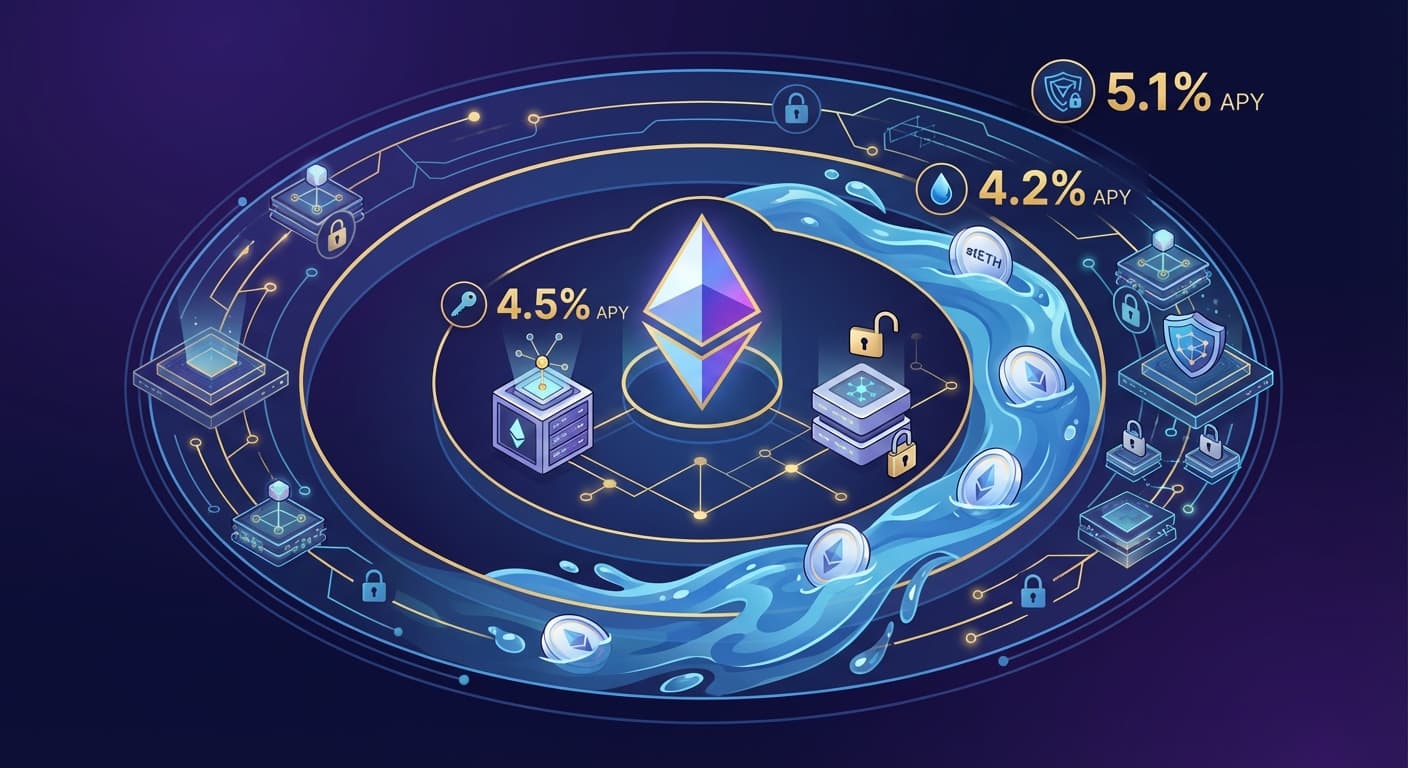
You hold ETH. It sits in a wallet, not doing anything. Meanwhile, roughly 37.5 million ETH — about a third of all ETH in existence — is actively securing the Ethereum network and collecting rewards every single day.
If you have ever asked "how do I actually get started with that?" — you are asking exactly the right question. This guide walks you through what staking is, which method fits your situation, how to execute it step by step, and what can go wrong. Read it all before you commit a single coin.
Not financial advice (NFA). Staking carries real risks including slashing, smart contract bugs, exchange insolvency, and market volatility. Only stake what you can afford to keep locked — or to lose entirely in a worst case. Always do your own research (DYOR).
Why Stake? What Ethereum Staking Actually Does
Think of Ethereum staking like joining a cooperative neighborhood watch — one that pays you. You pledge ETH as a security deposit, take turns validating transactions alongside hundreds of thousands of other participants, and in return you receive a share of protocol rewards and transaction fees. Behave honestly and you keep earning. Cheat, or make certain serious configuration mistakes, and a portion of your pledge gets "slashed" — burned by the protocol.
This mechanism has been the backbone of Ethereum since the network switched from Proof of Work to Proof of Stake (PoS) in September 2022. As of early 2026, more than 950,000 active validators secure the chain. Whether you run one of those validators yourself or delegate through a protocol, you are participating in the same underlying system.
It is worth being direct here: staking is not a risk-free savings account. The analogy to a bank deposit breaks down as soon as you look at the actual risk profile. Keep that in mind throughout this guide.
What You Will Need Before You Start
Requirements differ depending on which staking path you choose:
| Method | ETH Required | Technical Skill | Who Holds Your ETH |
|---|---|---|---|
| Exchange staking | ~0.001 ETH | None | The exchange |
| Liquid staking | Any amount | Basic wallet skills | Self-custody wallet |
| Solo staking | 32 ETH | Server administration | Full self-custody |
| Restaking | Existing LST | Intermediate DeFi experience | Self-custody wallet |
For liquid staking, solo staking, and restaking, you also need a self-custody wallet (MetaMask or Rabby are the most common choices) and a small ETH buffer specifically for gas fees — separate from the amount you intend to stake.
Step-by-Step: Choose Your Path and Execute
Step 1 — Match Yourself to a Method
| Your Situation | Recommended Path |
|---|---|
| First time in crypto, want the simplest option | Exchange staking |
| Comfortable with DeFi, want yield plus liquidity | Liquid staking (Lido stETH) |
| Technical user, own 32 ETH, want maximum decentralization contribution | Solo staking |
| Already liquid staking and want to layer additional yield | Restaking (EigenLayer) |
Step 2 — Set Up Your Starting Point
- Exchange staking: Create and verify an account on a supported exchange (Coinbase, Kraken, Binance). Fund with ETH.
- Liquid / solo / restaking: Install MetaMask or Rabby, write down your seed phrase on paper and store it somewhere offline and physical — never in a photo, a cloud note, or a messaging app. Then transfer ETH to your wallet.
Step 3 — Execute Your Chosen Path
Path A — Exchange Staking (Lowest Barrier)
- Log in to your exchange account.
- Navigate to the Staking or "Earn" section.
- Select Ethereum (ETH) and enter the amount you want to stake.
- Confirm — rewards typically begin accruing within 24 hours.
What to know: Exchange staking hands custody of your ETH to a third party. APY is generally lower (approximately 2.5–3.2%) than self-custody options, and the platform's solvency becomes your risk. Always check whether the exchange holds staking assets in segregated accounts, separate from operating funds.
| Exchange | Approximate APY | Minimum | Lock Period |
|---|---|---|---|
| Coinbase | ~3.2% | None | Flexible |
| Binance | ~2.8% | 0.001 ETH | Flexible |
| Kraken | ~3.0% | 0.01 ETH | Flexible |
Warning
If the exchange is hacked or becomes insolvent, your staked ETH may be at risk. "Not your keys, not your coins" applies here.
Path B — Liquid Staking with Lido (Most Popular)
- Open MetaMask or Rabby and confirm you have ETH plus a small buffer for gas.
- Navigate to stake.lido.fi using a bookmark you saved yourself — never a link from social media or a DM.
- Click Connect Wallet and select your wallet.
- Enter the amount of ETH you want to stake.
- Click Stake and approve the transaction in your wallet.
- You will receive stETH in your wallet. It rebases daily to reflect accumulated rewards.
- Hold stETH to keep earning, or deploy it across DeFi protocols — use it as collateral on Aave, participate in AMM liquidity pools, or explore yield farming strategies.
stETH usage flow:
ETH → Deposit to Lido → Receive stETH (base APY ~3.7%)
         ↓
stETH → Collateral on Aave → Borrow USDC → Additional DeFi strategies
Other liquid staking options beyond Lido:
| Protocol | LST Token | Approximate APY | Market Share |
|---|---|---|---|
| Lido | stETH | ~3.7% | ~80% |
| Rocket Pool | rETH | ~3.5% | ~6% |
| Coinbase | cbETH | ~3.2% | ~5% |
| Frax | sfrxETH | ~3.8% | ~2% |
Key tradeoff: Liquid staking is far more accessible than solo staking, but you are trusting the protocol's smart contracts with your ETH. No smart contract — however thoroughly audited — carries zero risk.
Path C — Solo Staking (Maximum Contribution)
Running your own validator gives you the highest direct contribution to Ethereum's decentralization. It also requires 32 ETH, hands-on technical setup, and ongoing operational responsibility.
Hardware minimum: 16 GB+ RAM, 2 TB+ SSD, stable 24/7 internet connection.
Software: You need both an execution client (Geth or Nethermind) and a consensus client (Lighthouse or Prysm) running simultaneously and kept in sync.
Tip
In March 2026, Vitalik Buterin proposed DVT-Lite — a Docker-based setup that reduces validator deployment to a single container command. His stated goal: "The idea that 'running infrastructure' is this scary, complicated thing where each person must be a 'professional' is awful and anti-decentralization — we must attack it directly." If DVT-Lite gains broad adoption, the technical bar for solo staking could drop considerably.
Solo staking is executed through the official Ethereum Launchpad. The deposit is irreversible once submitted — read every step carefully before signing.
Path D — Restaking (Advanced)
Restaking means taking your already-staked ETH or LST tokens (like stETH) and pledging them a second time to secure additional networks, earning rewards layered on top of your base staking yield.
ETH → Lido (stETH, base APY)
         ↓
stETH → Deposit to EigenLayer
         ↓
EigenLayer → Provides security to AVS (Actively Validated Services)
         ↓
AVS fees → Distributed to restakers| Protocol | Approximate TVL | Additional APY (approximate) |
|---|---|---|
| EigenLayer | ~$13B | +1–5% |
| Symbiotic | ~$2B | +1–3% |
| Karak | ~$1B | +1–4% |
Warning
Restaking compounds yield and risk simultaneously. Slashing exposure stacks across layers — an AVS security failure can put your principal at risk even if your underlying Ethereum validator behaves perfectly. Only pursue restaking after you thoroughly understand base staking first.
Best Practices and Tips
- Start with a small test amount. Regardless of method, run through the full process with a minimal deposit before committing larger sums. This surfaces any wallet or interface issues without high stakes.
- Bookmark official URLs. Phishing clones of staking protocols are sophisticated and common. Never connect your wallet from a link sent in a DM or posted in a public forum.
- Use a hardware wallet for significant positions. Ledger and Trezor keep your signing keys offline, meaningfully reducing software vulnerability exposure.
- Watch gas timing for liquid staking. ETH gas fees fluctuate — transacting during lower-congestion windows (often late night or early morning UTC) can save a meaningful amount on larger deposits.
- Set up monitoring if you run a solo validator. Prolonged missed attestations reduce rewards. They do not trigger slashing on their own, but an unmonitored node drifting offline costs you quietly over time.
- Consider spreading across protocols. Concentrating all your liquid-staked ETH in a single protocol means a single smart contract incident wipes you out. Splitting between Lido and Rocket Pool hedges that risk.
Common Mistakes and Risks
Running Duplicate Validators — Slashing
The most common cause of slashing for solo stakers is migrating to new hardware while accidentally running two instances of the same validator key simultaneously. Never start a new validator node before the previous one is completely shut down and confirmed offline. One key, one machine, at all times.
Smart Contract Vulnerabilities
Liquid staking protocols are smart contracts. Even heavily audited code carries non-zero risk. In March 2026, an Aave wstETH price oracle glitch triggered approximately $27 million in liquidations — a real-world reminder that battle-tested protocols are not bulletproof.
Exchange Counterparty Risk
Exchange staking means your ETH sits on the exchange's books. If the exchange is hacked or becomes insolvent, staked ETH may be unavailable or lost. Check whether staked assets are legally segregated from exchange operating funds before committing.
Centralization Risk
Lido controls approximately 80% of the liquid staking market. If a single entity came to control a majority of all Ethereum validators, the network's censorship resistance would be at risk. Supporting alternatives like Rocket Pool, DVT-based validators, and decentralized staking pools is meaningful for long-term network health.
Tax Implications
Staking rewards may be taxable as income in your jurisdiction at the time you receive them. In other jurisdictions, tax applies only at disposal. The rules vary widely — consult a tax professional who specializes in crypto before you start receiving staking income. Understand the difference between DeFi protocols and centralized services as tax treatment can differ.
Quick Checklist Before You Stake
Use this before executing any transaction:
- I have chosen a staking method and understand how it works
- I know which risks apply to my chosen method (slashing / smart contract / counterparty)
- For self-custody methods: seed phrase is backed up on paper, stored offline — not in any cloud or photo app
- For liquid staking: I am on the official protocol URL via a bookmark, not a clicked link
- For solo staking: I have tested my node setup and will never run duplicate keys simultaneously
- For restaking: I understand base staking first, and I understand compounded slashing risk
- I am only staking an amount I can afford to keep locked — or to lose in the worst case
- I have looked into the tax treatment in my jurisdiction, or will consult a professional before rewards accumulate
Frequently Asked Questions
Can I withdraw staked ETH anytime?
With liquid staking (Lido, Rocket Pool), you can sell your LST tokens on the open market at any time — no withdrawal queue required. Direct protocol withdrawals from Lido are available but may take hours to days depending on queue depth. Solo staking withdrawals go through the validator exit queue, which can take several days depending on network conditions.
Will staking yields stay the same?
No. As more ETH is staked, base protocol APY decreases — this is a supply-and-demand mechanic built directly into the protocol. APY has declined from roughly 5% in early 2022 to approximately 3.5–4.2% as of 2026. Future rates depend on total staked ETH, MEV activity, and protocol upgrades. Do not build a budget around a specific number.
Is liquid staking safer than solo staking?
Each carries different risks, not categorically better or worse ones. Solo staking avoids smart contract risk but introduces slashing, downtime risk, and significant technical complexity. Liquid staking avoids direct slashing risk for the user but introduces smart contract risk and protocol concentration risk. There is no risk-free option — understanding impermanent loss and DeFi risks broadly helps calibrate these tradeoffs.
What if the liquid staking protocol gets exploited?
In a serious smart contract exploit, deposited ETH could be partially or fully lost. Lido and Rocket Pool maintain bug bounty programs and undergo regular audits, but past audits do not guarantee future safety. This is why position sizing and protocol diversification matter more than audits alone.
Do other blockchains have staking too?
Yes. Polkadot overhauled its staking with a March 2026 update, cutting the unbonding period from 28 days to 24–48 hours. Solana, Cosmos, and virtually all modern PoS chains run their own staking ecosystems with varying yield profiles and risk characteristics. What qualifies as a validator, how slashing works, and what the tax treatment is can differ substantially across chains.
What about restaking — is it worth it?
Restaking can add yield on top of base staking, but it also compounds risk. It is not a necessary step — plenty of stakers participate through liquid staking alone. Only pursue restaking once you have a solid grasp of how base staking works, what slashing means, and how the specific AVS you are securing operates.
Wrapping Up
Ethereum staking offers a way to participate directly in the network's security infrastructure — and, depending on the method, to put idle ETH to work. The key is matching method to your situation: start with exchange staking if you are new, move to liquid staking if you want more control and better yield, and only approach solo staking or restaking when you genuinely understand what you are signing up for.
Start small. Secure your seed phrase offline. Stake only what you can afford to keep locked — or, in a worst case, to lose.
Note
This article is for informational purposes only and does not constitute investment or financial advice. Staking rewards are not guaranteed, and past yield rates do not predict future performance. Staking carries risks including slashing, smart contract vulnerabilities, exchange counterparty risk, and market volatility. Always do your own research (DYOR) and consult qualified professionals before making financial decisions. NFA.
Keep learning

Ethereum Validator Consolidation: How MaxEB and EIP-7251 Work
Learn how Ethereum validator consolidation, Type 2 withdrawal credentials, and the 2,048 ETH maxEB limit work—and what operators should check first.
 GOMTU8 min read
Ethereum Validator Slashing Explained: Penalties, Causes, and Prevention
Understand Ethereum validator slashing, how it differs from ordinary downtime penalties, what triggers it, and how solo stakers can reduce operational risk.
GOMTU8 min read
DEX vs CEX: A Practical Comparison for Crypto Users
Centralized or decentralized exchange — which one fits you? Compare security, fees, custody, and use cases to find out what actually matters for your situation.
GOMTU7 min readExplore related topics

Cross-Chain Bridge Guide: How to Bridge Safely in 2026 (Step-by-Step)
Learn how to use cross-chain bridges safely: what they are, how lock-and-mint and liquidity pool bridges work, a step-by-step tutorial, and how to avoid the hacks that cost DeFi over $2.8B.
GOMTU9 min read
Polkadot Halving 2026: DOT Supply Cap, 53.6% Emission Cut Explained
Polkadot undergoes its first-ever tokenomics overhaul on March 14, 2026 — a 2.1B DOT supply cap, 53.6% emission cut, and staking redesign. Here is what the changes actually mean.
GOMTU8 min read