Restaking Explained: EigenLayer, LRTs, and Shared Security (2026)
What is restaking, and why did it become one of the biggest DeFi narratives of 2026? A clear breakdown of EigenLayer, AVSs, liquid restaking tokens, and the stacked risks — before you chase the yield.


Restaking went from a niche idea in 2023 to one of the loudest narratives in DeFi by 2026 — with roughly $18–19.5 billion in value committed across the sector and more than 3.5% of all ETH pledged into it. The pitch is genuinely clever: take ETH you already staked, and put it to work a second time. But "earn twice on the same coins" is exactly the kind of phrase that should make you slow down, not speed up.
This guide walks through what restaking actually is, how EigenLayer and liquid restaking tokens work, what the real yield looks like, and — most importantly — how the risks stack on top of each other. Read the risk section before you touch any of this.
Not financial advice (NFA). Restaking layers new risks on top of staking risks. Yields are variable and not guaranteed, and a single smart contract failure can affect your principal. Only commit funds you can afford to lose entirely, and always do your own research (DYOR).
What Is Restaking?
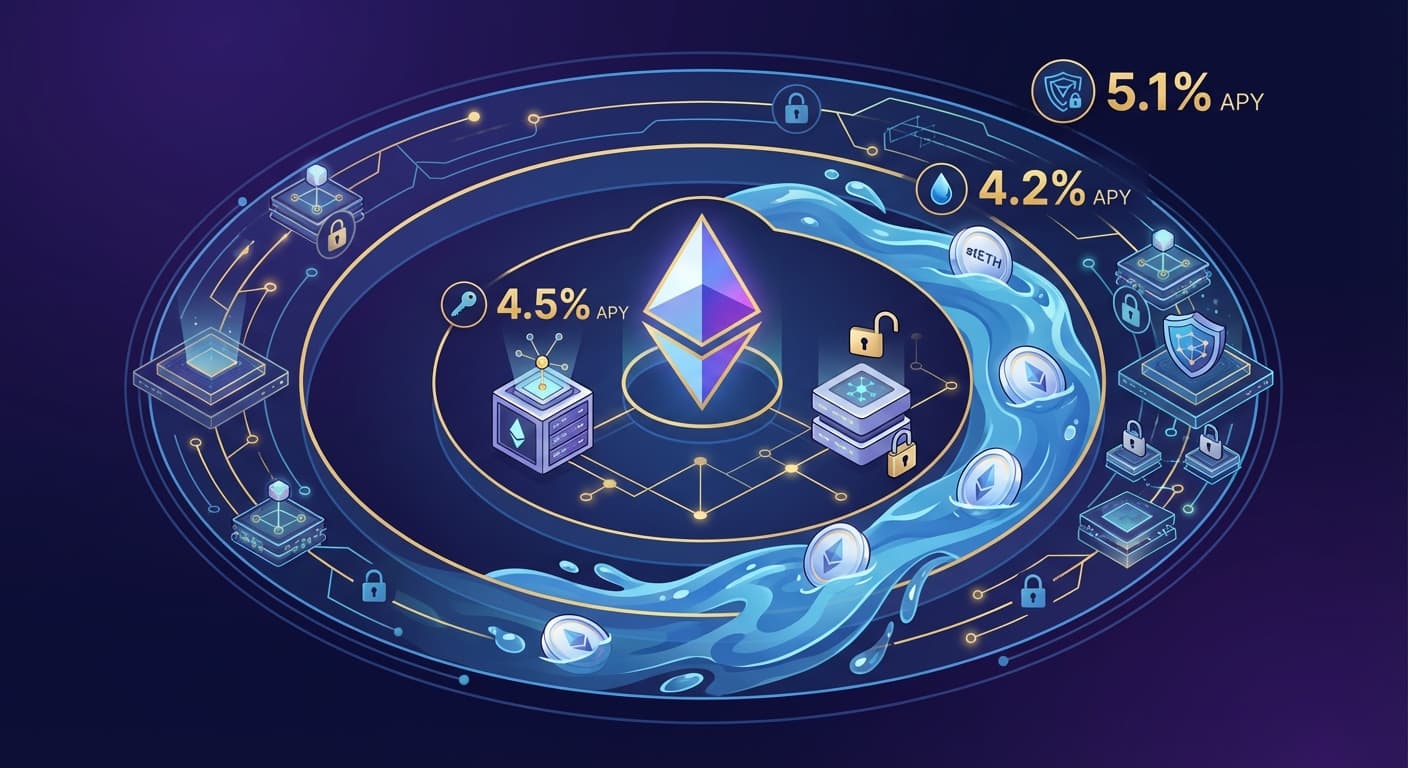
Think of your staked ETH like a security guard you've already hired to protect one building — the Ethereum network. That guard earns a steady wage (your staking reward). Restaking is like sending that same guard to also watch a second and third building down the street, collecting extra pay from each.
More precisely: restaking lets you reuse ETH that's already staked (or a liquid staking token like stETH) to help secure additional services beyond Ethereum itself. In return, those services pay you on top of your base staking yield.
The catch is baked into the analogy. One guard watching three buildings is stretched thinner. If the guard messes up at any building, they can be penalized — and that penalty comes out of the same paycheck backing all three jobs. That's the core trade-off of restaking, and everything below is really just detail on top of it.
How Restaking Works: EigenLayer, Operators, and AVSs
EigenLayer introduced restaking to Ethereum in 2023 and, as of 2026, holds roughly 94% of the market. Three pieces make the system run:
- Restakers — people who deposit ETH or liquid staking tokens into the protocol, offering their stake as security-for-hire.
- Operators — technical participants (1,900+ active in early 2026) who actually run the software that secures the extra services. Restakers delegate to them.
- AVSs (Actively Validated Services) — the "buildings" being guarded. An AVS is any external service that wants economic security but doesn't want to bootstrap its own validator set from scratch.
Instead of every new protocol having to recruit its own stakers, an AVS can rent Ethereum's already-staked security. The first generation of AVSs is live and paying rewards — including EigenDA (a data-availability service), plus several oracle and bridge-verification networks.
ETH → Staked on Ethereum (base reward)
        ↓
Staked ETH → Restaked via EigenLayer
        ↓
EigenLayer → Delegated to an Operator
        ↓
Operator → Secures one or more AVSs
        ↓
AVS fees + token rewards → Flow back to you
Native Restaking vs. Liquid Restaking Tokens (LRTs)
There are two ways in, and the difference matters for both convenience and risk.
Native restaking means locking your ETH (or LST) directly into EigenLayer. Your capital is committed and illiquid while it sits there — you can't simultaneously use it elsewhere in DeFi.
Liquid restaking solves that liquidity problem the same way liquid staking did. You deposit into a protocol, and it hands you a liquid restaking token (LRT) representing your restaked position. That token keeps earning while staying tradable and usable across DeFi.
| LRT Protocol | Token | Distinguishing Feature |
|---|---|---|
| ether.fi | eETH | Deepest TVL of any LRT; non-custodial — you keep control of your withdrawal keys |
| Renzo | ezETH | Most aggressive multi-chain expansion (Arbitrum, Blast, Linea, Mode, and more) |
| Kelp DAO | rsETH | Popularized the "points farming" meta during the early restaking boom |
Here's the honest part: an LRT looks like a simple yield-bearing token in your wallet, but underneath it may be exposed to the slashing conditions of multiple AVSs you never personally chose. The yield shows up clearly. The risk is buried several contracts deep. That opacity is the defining feature of liquid restaking — convenient on the surface, complicated underneath.
What Does Restaking Actually Yield?
Real restaking yield in 2026 typically lands around 4–6% a year: roughly 3–4% from base Ethereum staking, plus 1–2% from AVS rewards. That's the sober number.
You'll see much bigger figures advertised. A few things to keep straight:
- Most rewards today come from token emissions, not fees. A large share of restaking yield is EigenLayer distributing its own EIGEN token to attract capital — not organic revenue from AVS fees. Emission-driven yield can shrink or disappear as programs wind down.
- "12–20% APY" usually means recursive loops. Those figures come from strategies that redeposit LRTs into lending markets like Aave or Morpho to borrow and restake again. That's leverage. It carries liquidation risk and is not passive income — it's an active, fragile position.
The Risks: Where Yield and Danger Stack Together
This is the section that matters most. Restaking doesn't just add yield — it adds correlated, compounding risk.
Slashing is live and real. EigenLayer's slashing went live on mainnet in 2025 and is fully operational in 2026 (the protocol can now even redistribute slashed funds rather than just burning them). If an operator you delegated to violates an AVS's rules, part of the underlying stake can be penalized.
Slashing exposure stacks across layers. This is the whole point of the security-guard analogy. When the same stake secures several AVSs, a failure at any one of them can hit your principal — even if your base Ethereum validator behaved perfectly.
Smart contract risk is not theoretical. In April 2026, a Kelp DAO exploit caused roughly $300 million in losses and triggered an estimated $5.4 billion in sector-wide withdrawals. Battle-tested and audited does not mean safe.
LRTs can depeg. During market stress, a liquid restaking token can trade below the value of the ETH backing it. If you need to exit in a hurry, you may take a loss on the token price on top of everything else.
Systemic risk to Ethereum itself. If restaking grows large enough, a major slashing event could trigger mass unstaking and ripple back into the stability of the base network — a concern researchers and the Ethereum community actively track.
Warning
The convenience of a liquid restaking token hides how many slashing conditions your ETH is actually exposed to. Before depositing, understand which AVSs a protocol secures and what could trigger a penalty — don't rely on the yield number alone.
Is Restaking Right for You?
Restaking is an advanced DeFi activity. A reasonable order of operations:
- New to earning on ETH? Start with base staking — understand slashing, custody, and yield there first.
- Comfortable with liquid staking and DeFi? You can explore restaking, but keep positions small and diversified across protocols.
- Chasing 15%+ recursive-loop APY? Make sure you fully understand liquidation mechanics and impermanent loss before you leverage anything. This is not passive yield.
There is no version of restaking that is "safe, high-yield, and effortless." Anyone selling it that way is skipping the risk section.
Frequently Asked Questions
Is restaking the same as staking?
No. Staking secures one network (Ethereum) with your ETH. Restaking reuses that same staked ETH to secure additional services on top, earning extra rewards — and taking on extra slashing exposure for each service.
What is an AVS in simple terms?
An Actively Validated Service is any external protocol — a data-availability layer, an oracle, a bridge — that "rents" Ethereum's restaked security instead of building its own validator network from scratch. AVSs pay restakers for that borrowed security.
Do I need to be technical to restake?
Not necessarily. Liquid restaking protocols like ether.fi or Renzo let you deposit and receive an LRT without running any infrastructure yourself. But "easy to deposit" doesn't mean "low risk" — the underlying slashing and smart contract exposure is the same.
Can I lose my principal?
Yes. Through slashing (across any AVS your stake secures), a smart contract exploit, or an LRT depeg during stress, your underlying ETH is genuinely at risk. This is not a savings account.
Why is so much restaking yield paid in tokens?
Much of the advertised yield comes from EigenLayer distributing its EIGEN token to attract capital, rather than from organic AVS fees. Token-emission yield can shrink over time, so today's headline APY is not a reliable forecast of future returns.
Wrapping Up
Restaking is a genuine innovation — a way to turn Ethereum's idle security into a shared resource that new protocols can rent. That's why it grew into an ~$18 billion sector in just a few years. But the same mechanism that stacks the yield also stacks the risk: slashing across layers, smart contract exposure, LRT depegs, and yields that lean heavily on token emissions.
If you explore it, start after you understand base staking, keep positions small, diversify across protocols, and read what each LRT is actually exposed to. Treat any "double your yield, no downside" pitch as a red flag — because the downside is exactly what those pitches leave out.
Note
This article is for informational purposes only and does not constitute investment or financial advice. Restaking yields are variable and not guaranteed, and past performance does not predict future results. Restaking carries risks including multi-layer slashing, smart contract exploits, liquid restaking token depegs, liquidation risk in leveraged strategies, and market volatility. Always do your own research (DYOR) and consult qualified professionals before making financial decisions. NFA.
Keep learning
Ethereum Staking Guide: How to Stake ETH Step by Step (2026)
A practical how-to for staking ETH in 2026 — choose your path, set up step by step, and understand the real risks before you commit. Covers solo, liquid, exchange, and restaking.
 GOMTU10 min read
How to Start Yield Farming: A Step-by-Step DeFi Guide
Learn how to start yield farming in DeFi — wallet setup, platform selection, step-by-step deposits, risk management, and a pre-deposit checklist. NFA.
GOMTU9 min read
Impermanent Loss Explained: The Hidden Cost of DeFi Liquidity
Understand impermanent loss in plain language — what it is, when it hurts most, how to reduce it, and the risks every DeFi LP should know before depositing.
GOMTU8 min readExplore related topics

Crypto Airdrop Farming Guide 2026: Qualify Without Gambling Your Wallet
A practical crypto airdrop farming guide for 2026: evaluate campaigns, limit wallet risk, verify claims, keep records, and avoid Sybil abuse.
GOMTU8 min read
Cross-Chain Bridge Guide: How to Bridge Safely in 2026 (Step-by-Step)
Learn how to use cross-chain bridges safely: what they are, how lock-and-mint and liquidity pool bridges work, a step-by-step tutorial, and how to avoid the hacks that cost DeFi over $2.8B.
GOMTU9 min read