ERC-4337 Paymasters Explained: How Gas Sponsorship Works
Learn how ERC-4337 paymasters sponsor gas, support token fee payments, and introduce security and availability trade-offs for smart-wallet users.

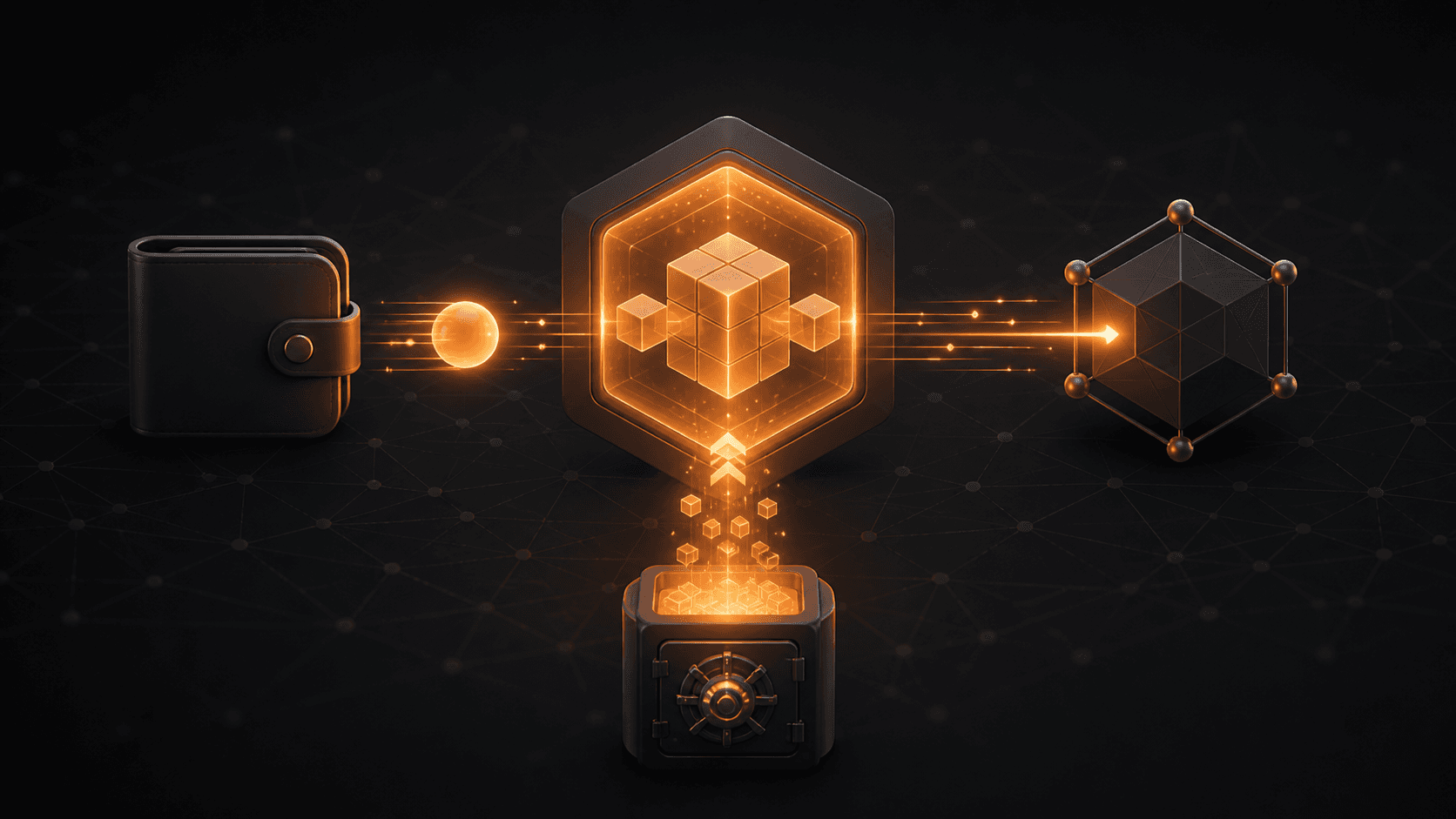
Holding USDC but no ETH can leave you unable to move your own tokens. ERC-4337 paymasters address that awkward moment by changing who settles the network fee—not by making computation free. They are one part of crypto wallet security, because smoother onboarding also creates new sponsorship rules, dependencies, and signing risks you should understand.
Important
“Gasless” describes the user's experience. Validators still receive the chain's native gas token, funded by a sponsor or recovered from the user through another asset. This guide is educational, not financial advice (NFA).
What Is an ERC-4337 Paymaster?
A paymaster is a smart contract that can agree to cover the gas cost of an ERC-4337 UserOperation. The user creates the requested action, a bundler submits it through the EntryPoint contract, and the paymaster's rules decide whether sponsorship is allowed.
Think of a paymaster like a shipping account at an online store. The courier still charges for delivery. At checkout, however, the store can use its corporate account, or it can charge you in store credit while paying the courier in the currency the courier accepts. The delivery is not free; the payer and payment experience changed.
Ethereum's account-abstraction roadmap identifies gas sponsorship and fee payment in non-native tokens as smart-wallet capabilities. The normative ERC-4337 specification defines the paymaster fields and EntryPoint interactions behind that experience.
How Gas Sponsorship Works
The simplified flow has six steps:
- Your smart wallet builds a UserOperation. It describes the account action, gas limits, fees, signature, and optional paymaster data.
- A sponsorship service checks policy. It may verify the app, account, call target, quota, expiry, or a server-issued authorization.
- The paymaster data is attached. This identifies the paymaster and carries the information needed for validation.
- A bundler simulates the operation. Simulation helps detect invalid or underfunded requests before the bundler spends gas on-chain.
- EntryPoint validates and executes. It asks the account and paymaster to validate, then calls the requested application if the checks pass.
- The final cost is settled. The EntryPoint deducts native-token gas from the paymaster's deposit. A post-operation step can complete accounting, including charging the user in an ERC-20 token.
The current ERC-4337 interface separates the paymaster address, validation gas limit, post-operation gas limit, and paymaster data. That detail matters to developers, but users mainly need to know that the sponsor makes a conditional promise backed by an on-chain deposit.
Sponsored Gas vs Paying Gas With Tokens
These experiences are often grouped under “gasless,” but they use different economics.
| Model | Who ultimately bears the cost? | What the user sees | Typical use |
|---|---|---|---|
| App-sponsored | The app or campaign | No gas charge | First transaction, onboarding, limited promotion |
| Subscription or quota | A service | Included allowance | Games, memberships, enterprise workflows |
| ERC-20 fee payment | The user, through a token | Fee quoted in a supported token | User has USDC but no ETH |
| Conditional sponsorship | Sponsor if rules pass | Free only for eligible calls | Specific contract, action, or time window |
With token-based payment, the paymaster still pays native gas to the network. It then recovers value according to its rules. The exchange rate, markup, allowance, and refund method are implementation choices, so read the quote rather than assuming it is cheaper than paying ETH directly.
What a Paymaster Checks
A responsible paymaster does not sign a blank check. Depending on its design, it may restrict:
- the chain, account, destination contract, and function being called;
- maximum gas cost and fee levels;
- campaign dates, per-user quotas, or allowlists;
- an app-generated authorization signature and expiry;
- token balance, allowance, and exchange-rate conditions for ERC-20 payment.
The draft ERC-7677 paymaster service capability proposes a standard interface through which apps, wallets, and paymaster web services can coordinate. Its status matters: it is under peer review, so support should not be treated as universal or final.
Risks and Limitations
“Gasless” can hide the real price
A sponsored action may be genuinely paid by an app, limited to a promotion, bundled into another fee, or recovered in a token. Check the asset, amount, rate, and maximum charge. Convenience is not evidence of a favorable price.
Sponsorship can fail
Paymasters can reject an operation because a quota expired, the call is unsupported, the token allowance is insufficient, or their service is unavailable. A wallet should provide a clear fallback, but a failed sponsorship request can still interrupt an urgent transfer.
The sponsor has an abuse problem
If anyone could force arbitrary expensive operations, attackers could drain the paymaster's deposit. The official ERC-4337 paymaster documentation highlights deposits, staking, simulation, and strict validation as protections against griefing. Bugs in those rules can still waste funds or deny service.
Smooth prompts can lower your guard
No ETH payment does not make a call safe. A sponsored request can still grant a malicious token approval, transfer assets, or interact with an unsafe contract. Confirm the action, destination, amount, chain, and permission scope before signing.
Centralized services add dependencies
Many sponsorship systems use an off-chain service to rate-limit users or sign short-lived approvals. That service can censor requests, go offline, or leak policy credentials. Self-custody of the wallet does not guarantee permissionless access to a particular sponsor.
A User Safety Checklist
Before accepting sponsored gas or token-based fees:
- Confirm the request originated inside the official wallet or dApp.
- Read the actual action, recipient, token amount, network, and approval scope.
- Check whether the fee is sponsored or charged later in another token.
- Review the quoted token amount and any maximum charge or allowance.
- Reject unexplained unlimited approvals or calls you cannot decode.
- Know the fallback if the sponsor is unavailable—usually native-token gas.
- Test unfamiliar wallets and sponsorship services with a low-value account.
Clear signing remains essential. If the wallet cannot explain what the sponsored call will do, saving a small gas fee is not worth accepting an unreadable authorization.
Frequently Asked Questions
Are gasless transactions actually free?
Not at the network level. Someone still pays native-token gas. The app may absorb it, a service may include it in a plan, or a paymaster may charge you in another token.
Do paymasters work with regular Ethereum accounts?
Paymasters are part of ERC-4337 flows. Existing EOAs can participate through compatible smart-account systems, including designs that combine ERC-4337 infrastructure with EIP-7702 delegation. Wallet support and implementation details vary.
Can a paymaster take funds from my wallet?
A paymaster cannot ignore the authorization rules of your account, but the operation you sign may include a token transfer or approval used to collect fees. Read the complete call and allowance. A malicious dApp can also disguise harmful actions inside a smooth sponsored flow.
Why did my sponsored transaction fail?
Common reasons include an expired authorization, depleted quota, unsupported call, insufficient paymaster deposit, token price or allowance changes, simulation failure, or service downtime. The wallet should surface the reason and offer a native-gas fallback where possible.
Is ERC-7677 required for paymasters?
No. Paymasters already operate under ERC-4337 with service-specific APIs. ERC-7677 proposes a standard paymaster web-service capability, but it remains under review at publication time.
The Practical Takeaway
ERC-4337 paymasters remove a genuine onboarding problem: you can use a smart wallet without first acquiring the native gas token. They can sponsor a transaction outright or translate the fee into a token you already hold. The network fee remains real, and the experience depends on policy, software, liquidity, and service availability.
Treat gas sponsorship as a payment feature, not a security signal. Verify every call, understand who pays, and keep a native-gas fallback for important actions. For the broader architecture, start with account abstraction and smart wallets; for delegated EOAs, review the EIP-7702 security guide.
This article is educational and not financial advice (NFA). Do your own research (DYOR), verify wallet and paymaster documentation, and use only funds you can afford to lose.
Keep learning
Account Abstraction Explained: How Smart Wallets Work (2026)
Learn how account abstraction and ERC-4337 smart wallets work — seedless recovery, gasless transactions, and passkeys. A 2026 guide to smarter crypto wallets.
 GOMTU8 min read
EIP-7702 Wallet Delegation: A Practical Security Guide
Understand EIP-7702 wallet delegation, its smart-account benefits, phishing risks, warning signs, and a practical safety checklist.
GOMTU6 min read
Token Approvals and Wallet Drainers: How to Protect Your Crypto (2026)
Wallet drainers don't steal your keys — they trick you into approving them. How token approvals work, how drainers exploit them, and how to revoke access.
GOMTU6 min readExplore related topics
Pending Ethereum Transactions: Diagnose, Speed Up, or Cancel Safely
Learn why an Ethereum transaction stays pending, how nonce order and fees affect it, and when speeding up, canceling, or waiting is the safest response.
GOMTU7 min read
Polkadot Halving 2026: DOT Supply Cap, 53.6% Emission Cut Explained
Polkadot undergoes its first-ever tokenomics overhaul on March 14, 2026 — a 2.1B DOT supply cap, 53.6% emission cut, and staking redesign. Here is what the changes actually mean.
GOMTU8 min read